As the musical godfather of the genre this blog is based on, giving more attention to Buddy Holly should be a priority for me. Well, it’s unofficially Buddy Holly Week (September 7-13), so there’s no time like the present! Though, as with most things blog-wise, we take it up with a twist: an exploration of the many (many!) covers of Weezer’s iconic track from the Blue Album, “Buddy Holly.” There are an enormous number of covers of this song, most sounding like pale imitations of the original. I’m passing on most of those. I’m more drawn to the quirky, offbeat, creative re-inventions of the song. After all, a band as unique as Weezer deserves to be covered in style.
First up, Weezer of course. Their video for “Buddy Holly” deservedly earned praise from all quarters when it was released in September of 1994. I love how Ritchie Cunningham has more costume changes in this video than Cher in concert. As for covers, Weezer offers many choices, including the original Rivers Cuomo demo and various ‘live in the studio’ sessions for AOL and Spotify. Personally, I prefer the live acoustic version below from some unnamed 1990s TV appearance for its loose, wonderfully shambolic feel and in your face keyboard solos and background vocals.
Weezer – Buddy Holly (live acoustic)
Something about “Buddy Holly” has inspired people to take the song in all kinds of wacky stylistic directions. It can survive just about any treatment with its charm intact precisely because the bones of the song are so strong in terms of melody and structure. Parody band Richard Cheese and Lounge Against the Machine mangle the hell out of the song with their hilarious, deep-lounge version, complete with swelling strings on the closing. Nordloef give the song a kooky computer games instrumental workout that somehow avoids being pure novelty. Possibly my favourite instrumental of the tune is Gareth Pearson’s tight Bruce Cockburn-esque acoustic guitar treatment. Move over McKinley High, Straight No Chaser offer up a Glee-worthy, menace free, candy-coated arrangement that would have aced the finals.
Straight No Chaser – Buddy Holly
Now on to more recognizably rock and roll interpretations. The Holophonics give us a Madness-ska-like take, emphasis on the horn shots. Late Cambrian mine the same alt/indie vibe as Weezer but make some refreshing substitutions on the array of instruments soloing. Austin Parish slow things down in a breathy, Greenwich Village folky style. Extra bonus: their effort is part of a remake of the entire Blue Album from Midwest’s Finest, available for free download! Grayson Gilmour highlights the subtle, somewhat vulnerable side of the song with his mostly shy, solo piano rumination.
Ok, for something completely different, there’s Glowbug’s highly original and inventive remake of the song. It’s dissonant and over the top in a wonderful club-dancey sort of way. I’m including the Soundass brief instrumental excerpt because there’s something funny about the disastrous execution. The question mark added to the song title was the give-away, like the artist wasn’t sure if his efforts really warranted consideration as a cover proper. Scott Bradlee makes his piano keys jump on this jaunty instrumental ragtime performance. Whiskey Shivers give us a banjo-inflected country-ish take with particularly sweet harmonies in the chorus, a nice fiddle solo and apropos western whistling. Jarvis gets us back to basics with a stripped-down DIY acoustic vibe, fitted with a nice spacey keyboard solo.
But my undisputed fave cover is brand new from the TM Collective’s fabulous just-released tribute to BH, simply entitled Buddy Holly. TMC regularly release these sorts of tributes, so far covering the likes of Tom Petty, Wings, Nick Lowe, and many, many others. And they are all free, featuring performances from the crème de la crème of indie poprock darlings. This time they cover 16 different Holly tunes, sometimes twice. But some joker decided Weezer’s “Buddy Holly” should be added to the mix, done with an appropriately Buddy demeanor, featuring an “Everyday”-era celesta keyboard and Hollyesque vocal hiccups. Delightful! (“Buddy Holly” is track 19 on the album – just click through to the end, but check out all the great covers of Buddy Holly songs along the way!)
Let’s end on a light note. Ever since grungers starting having kids they’ve been Yellow Submarining their fave tunes to keep the tots (and themselves) entertained. Check out these two lullaby versions of “Buddy Holly” from Rockabye Baby and the Lullaby Players, the latter even retaining some of the tune’s darker melodic elements.
Lullaby Players – Buddy Holly
Given all the love for “Buddy Holly” it’s hard to believe that Weezer almost didn’t record it. Apparently producer Ric Ocasek had to convince Cuomo to cut it during the Blue sessions, suggesting they could make the decision about releasing it later. Good thing too or I would have had to come up with some other cleverism to celebrate Buddy Holly week.
It’s been five years since I embarked on this mad journey: to write a music blog. I dithered over the decision to start one for a number of months. There’s nothing more pathetic than to start something with maximum fanfare and enthusiasm, only to have it flame out a half dozen posts later. The questions I had to ask myself were: (a) was there enough of ‘my kind’ of music to regularly post about, and (b) could I sustain the effort to get regular posts up on the blog? Well here’s the proof. In five years I’ve managed to produce 347 blogs posts. I’ve written more than 170,000 words about poprock tunes. And, most importantly, I’ve featured almost 1000 different artists. Guess the answers to (a) and (b) are both a resounding yes!
I think the biggest reason this blog thing has worked out for me is that it is such a great outlet for being creative and having fun with something that has always been pretty central to my life: music. I love doing all the mock serious regular features (e.g. Breaking news, Around the Dial, Should be a hit single) and coming up with goofy themes as a way to feature different artists (e.g. “Telephonic Poprock,” “Summer’s Coming,” and the Cover me! series. Sometimes I’ve pushed the posts in more serious directions (“Is That So Gay,” “Campaigning for Hooks,” and “Pandemic Poprock“) but only if the melodies and hooks were there in abundance. The blog has also allowed me to pay tribute to my musical heroes (Buddy Holly, The Beatles, The Zombies, Elvis Costello, Nick Lowe, Marshall Crenshaw, Suzanne Vega, Aimee Mann). But, as regular readers know, such luminaries mostly appear as reference points to better help people get of a sense of what all these new acts are doing.
If you’ve just tuned in, I’m not assigning the past five years of posts as homework. Instead, I offer today’s anniversary post as a retrospective of what’s been happening here. I reviewed all 347 posts to pick out some choice examples of the range of styles I can cram under the rubrik of ‘poprock’. It wasn’t easy! My first go round produced a list of 118 songs. When I converted that to a playlist I got the number down to 81 tracks. Ack! Still too many. So I’ve broken things down into themes. This is not a ‘greatest hits’ or ‘best of’ Poprock Record. I’ve left out a lot of acts I really love. It’s just a representative sample of what goes on here, to borrow some lingo from my day job. Click on the highlighted band names to go to the original posts on the blog.
Let’s start by recognizing that not all that appears here is new. The blog has allowed me to explore a huge number of acts I’ve missed over the years, particularly in the 1990s when my new day job (academe) took over my life. I can’t believe I somehow missed great bands like Fire Town and the Soul Engines with their incredible guitar hooks. The Sighs “Make You Cry” is a pretty perfect poprock single. I knew about Billy Cowsills’ Blue Northern but had never heard of his later group, the Blue Shadows. And Eugene Edwards’ sole solo release, My Favorite Revolution, is a must add for any melodic rock and roll fan.
Fire Town – She Reminds Me of YouSoul Engines – Just Another DayThe Sighs – Make You Cry
Eugene Edwards – Congratulations My Darling
There have been acts that appeared again and again on the blog, my ‘old reliables’ as I might call them. These are performers I can pretty much carve out space in the queue for whenever I hear a new release is on the way. Gregory Pepper is probably my most covered artist. I love his quirky, always hooky, sometimes touching efforts. Ezra Furman was another great find who has an unerring knack of placing a memorable hook at the centre of whatever he’s doing, whether it’s retro 1950s pop or a punkish political ode. I discovered Jeremy Fisher long before the blog but I’ve used it to feature his work, old and new. He’s like a new wave Paul Simon with great videos. Edward O’Connell only has two albums, but they are reliably good. We really need a third. Mo Troper always delivers something wonderfully weird but still melodic and ‘can’t get it out of your head’ good. Finally, Jeremy Messersmith’s records regularly encompass big vision but he doles it out in memorable should-be hit singles.
Edward O’Connell – The End of the LineJeremy Messersmith – Fast Times in Minnesota
In my world of poprock, while any instrument goes, the electric guitar is arguably pretty central. Some bands really know how to ride a guitar-driven song right into your head. Jeff Shelton’s Well Wishers excel at putting the guitar up front. “Feeling Fine” is practically a ‘how to’ example of killer guitar-dominant poprock. The David James Situation and The Format are no slouches either. Jangle is a related field of guitar poprock and takes a number of forms, from the 1960s-inflected Byrds sound of The Vapour Trails to the more jaunty bubblegum feel of The Lolas “We’re Going Down to the Boathouse.” Jangle also usually features pretty addictive harmony vocals, showcased below in Propeller’s “Summer Arrives.”
David James Situation – I Should KnowThe Format – Wait Wait Wait
As the original and defining decade of poprock (in my view), the 1960s sound continues to be mined by new artists. Daisy House have few rivals in nailing the late 1960s California poprock vibe, sounding like time travelers from San Francisco’s 1968 club scene. Space Dingus have got The Monkees feel down. Both Shadow Show and The On and Ons gives us that rockier pop sound of the mid 1960s, with the latter delivering killer lead guitar hooks. By contrast, both Cut Worms and The Young Veins offer a candy-coated pop sound more akin to The Cyrkle and Simon and Garfunkel.
The On and Ons – Before Our EyesThe Young Veins – Cape Town
I’m a sucker for shivery harmony vocals so they’ve been featured regularly on the blog. One of Jenny Lewis’ side projects is the one-off album from Jenny and Johnny, I’m Having Fun Now. Aptly named, the record gently rocks and delivers amazing vocals. The Secret Sisters offer up a punchy tune where the harmony vocals seal the hooky deal. The Carousels “Call Along the Coast” has a big sound the rides a wave of harmony vocalizing and Beatlesque guitar work. Meanwhile Scotland’s Dropkick corner the market on delightful lilting songcraft on “Dog and Cat.” The blog sometimes shades into retro country and folk territory. Bomabil are an eccentric outfit who stretch our sense of song but never drop the melody. The Top Boost are pretty new wave but on “Tell Me That You’re Mine” they’re channeling Bakersfield via the Beatles 65. The Fruit Bats put the banjo upfront in “Humbug Mountain,” where it belongs. Gerry Cinnamon is like Scotland’s Billy Bragg and he shows what you can do with just an acoustic guitar and a Springsteen harmonica.
Jenny and Johnny – Scissor RunnerThe Secret Sisters – Black and BlueThe Carousels – Call Along the CoastGerry Cinnamon – What Have You Done
I’m proud to say that the blog has sometimes strayed off the beaten path of conventional poprock into more eccentric territory with bands that are smart and quirky and not afraid to lodge a hook in a more complex setting. Tally Hall pretty much define this approach. So ‘out there’ but still so good melodically. Chris Staples and Hayden offer up more low key, moody tunes but they still have a strong melodic grab. Overlord take clever to a new level, like a grad school version of They Might Be Giants. Coach Hop is just funny and hooky with his unabashed ode to liking Taylor Swift.
Tally Hall – Sacred Beast
Overlord – The Song That Saved the World
After the 1960s the new wave era is the renaissance of poprock for me with its combination of hooky guitars, harmony vocals, and melody-driven rock and roll. Screen Test capture this ambience perfectly on “Notes from Trevor” with a chorus that really delivers. The Enlows drive the guitar hook right into your head on the dance-madness single “Without Your Love.” Billy Sullivan epitomizes the reinvention of 1960s elements that occurred in the 1980s, well embodied in “Everywhere I Go.” Another strong theme in the blog has been the “I Get Mail” feature, populated largely by DIY songsters who write me about their garage or basement recorded releases. It is inspiring to hear from so many people doing their thing and getting it out there, especially when it is generally really good. Daveit Ferris is a DIY workaholic with an amazing range of song and recording styles. “Immeasurable” is a good illustration of his genius, with a banjo-driven chorus that always makes me smile. Mondello is practically the classic indie artist movie script, struggling to get an album out after 20 years. But then his follow up single, “My Girl Goes By,” is gold!
Screen Test – Notes from TrevorBilly Sullivan – Everywhere I GoDaveit Ferris – Immeasurable
I want to leave you with a two-four of should-be hits from Poprock Record. These songs are all quality cuts, grade A poprock with melodies and harmonies and hooks to spare. Some of these songs leave me panting, they’re so good. I kicked off the blog back in 2015 with Family of Year and I still think “Make You Mine” is a textbook should-be AM radio hit. Sunday Sun channel The Beatles through a 1980s song filter, in the very best way. Sitcom Neighbor’s “Tourist Attraction” is a delightful earworm affliction. Wyatt Blair has somehow boiled down the essential formula of a 1960s-influenced poprock hit. Wyatt Funderburk understands how to assemble the perfect melody-driven single. And so on. Get your clicking finger warmed up and you’ll be introduced to the essence of Poprock Record in 24 melodious increments.
Family of the Year – Make You MineEx Cops – JamesSitcom Neighbor – Tourist Attraction
The Primary 5 – MailmanDaisy – I Just Don’t Believe It
One thing I didn’t anticipate was all the great people I’d come in contact with writing a music blog. Thanks to all the bands, record labels, and readers who have responded so positively to what I’ve been doing here. A special thanks to Best Indie Songs, Tim at Powerpopulist and Don at I Don’t Hear a Single for their advice over the years and to my friends Rob at Swizzle and Dale at The View from Here for encouraging me to do this.
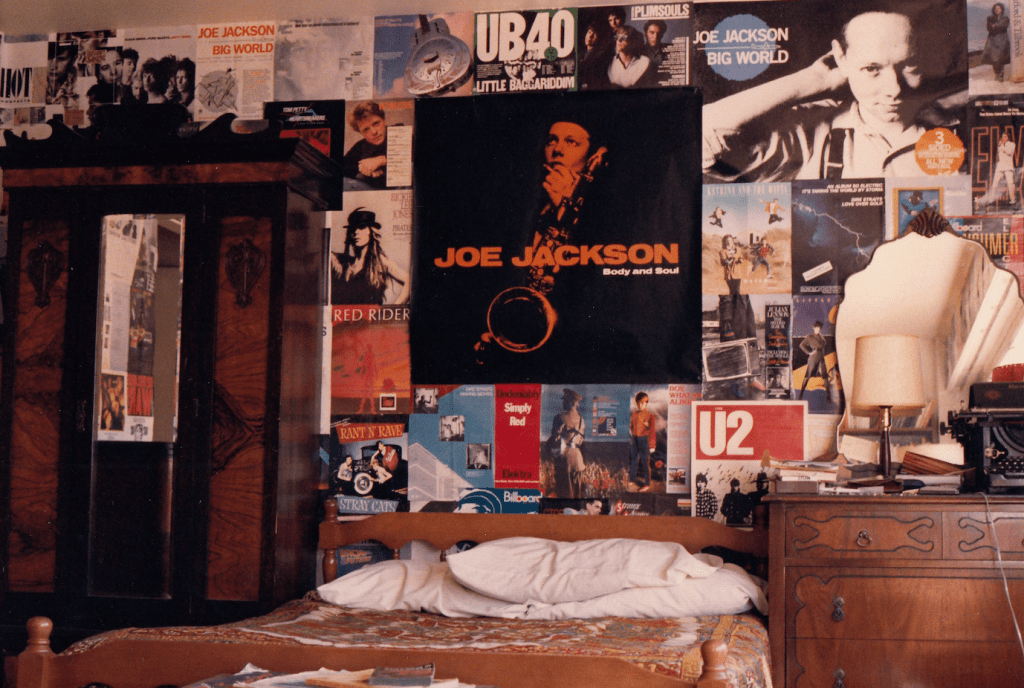
This post features pics from my poprock-postered 1985-7 apartment in Vancouver’s West End. Just $285 a month, all inclusive. No wonder I could buy so many records.
On the blogosphere there is already a clearly demarked niche music genre that combines melodic pop melodies with the classic rock and roll combo of electric guitars, bass and drums: power pop. Said to have been coined by no less an authority than Pete Townsend of The Who, the term ‘power pop’ is now applied to any band with jangly guitars, swooping background harmonies, and a strong melodic hook. My blogroll features two such sites (Absolute Powerpop and Powerpopaholic) and there are many more. So why cast my efforts under a different label like poprock? Well, simply put, I think poprock is a broader, more inclusive term. Or, to put it another way, while all of power pop could be considered a form of poprock, not all poprock would be characterized as power pop.
For many bloggers, power pop has become a kind of music esthetic: a certain kind of guitar sound, a particular combination of instruments and vocals, etc. Poprock, by contrast, is less rigid. It is less a genre than a sensibility, crossing over different styles. Sure it is defined by strong melodies and as a category it would make little sense if it didn’t relate to the rock and roll cannon. But rock and roll itself was a bastard child of multiple influences: south Chicago electric blues, Appalachian mountain fiddle solos and harmony vocals, western swing, and so on. What differentiates its many sub-genres is the balance of influences. Thus poprock takes a bit more of the swing and country than the blues while still set within the classic rock and roll combo. Here I’m thinking of Buddy Holly, the Beatles, the Steve Miller band (in the hits era), Marshall Crenshaw, The Smithereens, and, more recently, Bleachers.
So don’t get me wrong – I love power pop. It’s just that I like a lot of other things too.Bleachers website




 Poprock Record