When I first heard “Baby Ran” from their 1986 album 5440 (aka the green album) I was hooked. There was something so simple and catchy about the chorus, I couldn’t get it out of my head. Over the years, I kept buying their albums and CDs but reviewing them now I’m surprised how much of their material has always been folky and acoustic as well as jangly alt rock. The contrast is brought together on their latest release, La Difference, subtitled A History Unplugged. Some might complain that an ‘unplugged’ album is the last refuge of the musical scoundrel, where artists go when they have run out of ideas. But this effort really is a creative reinvention of the band’s singles catalogue. The most stark example is probably “Baby Ran,” which shifts from rock to country in this iteration without losing any of its hooky charm. Both new and old version appear below for easy comparison. The whole record is strong but for me the highlights include “One Day in your Life,” “I Go Blind,” and “Casual Viewin’.”
5440 are on tour across Canada this summer. Check out the dates and their catalogue on their website.
The music biz is an increasingly DIY affair, with everyone doing the McCartney I thing, i.e. writing, playing and producing everything or nearly everything on their records. Of course, today’s technology allows artists without a Beatlesque past to make some pretty sweet recordings. Case in point: Red Cabin, the tidy and picturesque project of Long Island, New York’s Jonathan Foster. Red Cabin ranges from the amplified home recording sound of his first album, Right This Way, and EP Wander in 2014, to the more complex and professional-sounding Camp Fire and White Morning, both released simultaneously in 2016. In the middle are some key transition singles, namely “The Pull” and “Patterns.” Linking all the changes is a keen attention to unusual vocal arrangements, amid fairly rapid shifts in musical attack – singular acoustic guitars suddenly flooded by electric instruments, or a full on band drops out to reveal just a guitar or keyboard part.
The root of my Red Cabin fever was the single “Patterns” with its eerie vocal delivery, hypnotic acoustic guitar rolls, and judicious use of electric keyboard, along with a killer chorus – a really perfect alt-pop single. A close second was “The Pull,” a swinging ditty released in the same period that featured a stylish red barn against a deep blue sky as its cover art. Going back in the catalogue, Right This Way’s title track and “First Things” caught my attention, as did “Another Time” from the Wander EP.
But they did not prepare me the double blast of Red Cabin albums early in 2016. Both Camp Fire and White Morning are stellar efforts. Camp Fire runs a gamut of styles, with electronic keyboards, acoustic and electric guitars, and tightly arranged vocals. “The Darkest Relief” reminds me a bit of Todd Rungdren, “I Want To” has a great soaring chorus melody line, “Secret Stories” exudes a lovely wistful quality with its acoustic guitar and arranged vocals, while “I Can’t Wait” has a more conventional poprock feel.
White Morning has the ambiance of a concept album, right down to the cover art. “Stuck” sounds a bit Weezer at times (in a good way), with a Beatles melody wash over the vocals, “All the Years” is a bit more indie poprock with great keyboards, guitar, and stronger, edgier vocals than Red Cabin typical, and “Juliet” has a nice swing with vocals that remind me of Tally Hall. Also, don’t miss Foster’s previous band, Snowday, whose 2013 single “Prickerbush” is a catchy number, again vibing on Weezer just a little.
Today’s musical DIY also extends to management, promotion and a one-man record label. So visit Red Cabin on Bandcamp where more of your hard-earned entertainment dollars will get into the hands of your favourite artists – or visit his Facebook page.
When people think “Bryan Adams” it’s easy to visualize the rock swagger or call to mind the many, many power ballads that have dominated wedding receptions from the mid-1980s on. But Adams is also a master of the polished poprock gem. The list of infectious hook-laden tunes is so long we couldn’t possibly recount them all here. His most recent album, 2015’s Get Up, is more proof he’s still got the knack for pumping out catchy songs. Producer Jeff Lynne does an amazing job of tweaking and sweetening the pop tinge with his signature suite of production techniques. There’s more than a little ELO flavour to tracks like “That’s Rock and Roll,” “Do What You Gotta Do,” and “Don’t Even Try,” the latter featuring a great Beatlesque guitar sound circa Beatles for Sale. Adams also gets back to his 1980s poprock roots on tracks “You Belong to Me,” “Go Down Rockin’” and “Yesterday Was Just a Dream.” But the standout track is “Brand New Day” with its driving, propulsive rhythm guitar that recaptures some of the excitement of his early to mid-1980s poprock glory days.
Listening to Get Up offered me a chance to revisit the Adams canon. Truth be told, Bryan and I had a falling out in the late 1980s. His follow up albums to Reckless moved away from the poprock hooks, either focusing on balladeering or working out some ‘rawk’ issues (see ‘swagger’). In a way it was understandable. By 1987 Adams had put out three killer albums in row but routinely would get trashed by the rock press who complained his work was clichéd and lacked authenticity. The final straw was when critics skewered him over his “Summer of ‘69” single because Adams was only 10 years old that year and could hardly have been the protagonist. What, did they think that Bowie really was an astronaut? Did they think Springsteen was the serial killer, state trooper and the guy avoiding the state trooper in those songs from Nebraska? In frustration, Adams crafted and refined his ‘rocker’ image on albums like Waking up the Neighbours and 18 till I Die. These albums were enormously popular but they didn’t really connect with me.
Lonely Nights
I had discovered Adams on a bus going downtown in Vancouver sometime in 1981. I was listening to CFOX on some strange FM-only portable radio when “Lonely Nights” came on: I was floored. I loved the shimmery lead guitar, what would become Adam’s signature crunchy rhythm guitar, and the tune. I immediately went downtown and picked up You Want It, You Got It. Side One of the album still blows me away: “Lonely Nights,” “One Good Reason,” “Don’t Look Now,” “Coming Home,” and “Fits Ya Good” – I could (and did) play it over and over. It remains my favourite Adam’s album (and my 16-year-old self did find Adam’s cover shot pretty cute). Cuts Like a Knife also had so many great tunes, though I would single out “This Time” as a pretty perfect poprock single. Reckless would be Adams’ masterpiece with nary a false move. Its key single, “Run to You,” is as good as poprock gets, a remarkable bit of songwriting, production, and arrangement. The atmospheric keyboard backdrop and ringing guitar lines alone are worth the price of the album.
I lost track of what Adams was doing around the early 1990s. Going back now, I am impressed with how much good poprock his post-1997 catalogue includes. 1998’s On a Day Like Today is particularly strong, with “How Do You Feel Tonight,” “On a Day Like Today,” and “Cloud Number 9.” But the monster single is undeniably the hooky “When You’re Gone.”
2004’s Room Service is another strong effort, with “Another East Side Story” clearly saying ‘I’m the single here’. Since then a host of other singles deserve mention: “The Best of Me,” “One World, One Flame,” “She Knows Me,” and “You’ve Been a Friend to Me.” Looking back over Adams’ canon, Ok, he’s definitely the ballad guy who likes to ‘rawk’ out, but his great talent, his authentic voice (for me), is his way with a tune. All the greats could craft a song that would get into your head and stay there – Adams has more than a few of those.
Bryan Adams hardly needs me to tell you how to find him on the internet but here is his official website and Facebook page.
… and you’re sitting, well, not on top of the world, but somewhere – interesting. Since 2004 California’s Rogue Wave have been releasing albums that tweak and redirect that state’s peculiar dream-state, inviting a melancholy re-assessment of life and the act of living it. Their 2005 single “Publish My Love” stood out from the pack of bands peddling acoustic-guitar based, pleasant-sounding pop songs for its starkly original sound: all the classic poprock motifs were there but somehow Rogue Wave put it together in a distinctive way.
Throughout their career the band has riffed on a number of key elements, rebalancing the mix through different albums and songs. “Nourishment Nation” from 2004’s Out of the Shadow leans on acoustic guitars up front, with other keyboards popping in here and there to push the song in different directions. “Salesmen at the Day of the Parade” from 2005’s Descended Like Vultures is a straightforward, somber, acoustic guitar ballad. “Lake Michigan” from 2007’s Asleep at Heaven’s Gate is a sonically brilliant pop tune, resting on a bed of highly original percussion.
“Solitary Gun” from 2010’s Permalight could slip easily on to your favourite Shins’ album with all the requisite acoustic guitar swing and pop hooks. “College” from 2013’s Nightingale Floors is classic Rogue Wave: chiming guitars, churning percussion, and a hummable tune.
Their new release is the whimsically-titled Delusions of Grand Fur and it reproduces all that the band excels at: highly textured production, a solid bed of acoustic guitars, creative instrumentation, and catchy tunes made more interesting by inventive vocal and percussion arrangements. Highlights include “In the Morning,” “Look at Me,” and the stunning, stand-out single, “California Bride” with its shimmering guitars and dreamy vocals.
Rogue Wave are currently on tour and no doubt would prefer to play packed houses everywhere. Find out more on their Facebook and band webpages.
Free Energy have a number irresistible singles across their two albums and EP. Things started off well with their debut song “Free Energy.” There is something audacious and mildly amusing about forcing deejays to say ‘here’s “Free Energy” by Free Energy!’ Say what? Even before they got their own material out, they had a killer cover of Springsteen’s “I’m Going Down.” Their 2010 debut album Stuck on Nothing channels a mixture of Bachman Turner Overdrive riffing with 1980s pop song sensibilities. “Light Love” has it all – swirling, candy-coated guitar sounds, fattened up vocals, and some great slow burn hooks. 2013’s Love Sign offers up more of the same, along with a few more languid pop gems, like “Dance All Night.” Free Energy are like a retro-1980s dance party band, but with fresh material. Since 2013, things have slowed considerably for the band, with some solo material from various band members emerging. However, their Facebook page did recently indicate that more would be coming from this band.
Light Love
You can find out more about Free Energy on their webpage and Facebook.
September 2012 I casually checked out something called iTunes Festival on the Apple TV home screen and accidentally discovered Jake Bugg. The feeling was electric. Kinda like when I saw Tracy Chapman open for John Martyn in Manchester in 1988 three months before her breakthrough appearance at the Nelson Mandela concert at Wembley Stadium in London – everyone in that northern club knew we had just seen a major talent. Bugg’s debut album came out in October and it did not disappoint. Everything that made his iTunes performance amazing was there. Shockingly, the album opened at number one on the British charts.
On My One
Many have written about Jake Bugg’s youth, his songs, guitar playing, and singing style, but what struck me as special about Bugg was his authenticity. His songs were all about working class life in middling England in the new millennium, something overlooked in most of popular culture. Indeed, the absence of any cultural mirror for the experiences of working class youth in most western countries makes the occasional mention stand out in stark relief. Bugg’s debut album gave voice to a generation left behind by the economy and the political class in songs like “Two Fingers,” “Seen It All,” and “Trouble Town.” Sure, some fans and music writers just listened esthetically, hearing the folk, folk blues, and rudimentary rock and roll sound, but the ability to speak authentically about his community’s class experience touched a nerve for those who were listening. However, after touring with the album for over a year, Bugg told journalists he doubted he could write about such experiences anymore because his life had changed so much.
Thankfully, Bugg was wrong, and his follow up record, Shangri La, kept developing themes of social inequality and class privilege (or the lack thereof) on tracks like “Messed Up Kids,” “Slumville Sunrise,” and “Kingpin.” Bugg’s style was not that of the protest singer or Clash-like sloganeering, but more of an artist’s rendering, a portrait of the world as he saw it. And, like Billy Bragg (another class-influenced singer-songwriter), he also wrote great love songs.
Bugg’s new album, On My One, is almost out and it appears to be similar to and different from his earlier material. The social themes remain but he pushes himself artistically into new genres. Growing up in the new century nobody consumes just one style of music so it was hardly surprising that Bugg’s talent could not be contained in just a few styles. “On My One” evokes the lonely solo acoustic guitar sound of Don McLean’s American Pie album, specifically “Vincent” and “Till Tomorrow,” while drawing from Bugg’s experience as a performer on tour. “Love, Hope and Misery” confirms Bugg’s talent for remaking the American blues ballad in his own style. But my favourite amongst the currently available selections from the record is “Bitter Salt,” a song unlike anything Bugg has done to date, a catchy poprock effort with a punchy arrangement and solid hooks.
Bitter Salt
Though reviewers tend to suggest that Bugg is rather subdued in concert, he is well worth the ticket price if you can see him on tour. Find out about his shows and recordings on his website and Facebook page.
Back in 1996 I got my copy of One Chord to Another and thought it was pretty cool, but frankly I was a bit distracted. I didn’t give it the worship it deserved. Reviewing it now I can better appreciate how this band had it all going on – great sound, solid hooks, and a palpable authenticity. How did Nova Scotia produce such a monster act? Their first EP Peppermint and full length album Smeared had a great indie sound, with both versions of “Underwhelmed” worth hitting repeat on. But their first major label effort, 1994’s Twice Removed, announced the arrival of a polished and original musical force, with “Penpals” a great weird single. Then they turned around and dumped their major label (Geffen) and turned out another great record, 1996’s One Chord to Another, spending one-tenth the budget of the previous one. While the album is bursting with great tracks, I’m partial to the very Beatle-esque “The Lines You Amend.” Talk was, Sloan would be the next big thing worldwide. But things didn’t really pan out that way.
Earlier this month I saw Sloan play One Chord to Another in its entirety at the Phoenix in Toronto as part of 20th anniversary tour commemorating the album. The show was broken into two sets, with the first blasting through OCTA and the second drawing from their other ten albums. Despite owning three of their records, I couldn’t name a single tune, though their audience was pretty well informed, drowning out the band on a few sing-a-longs. After such an amazing show, I decided to school myself on all things Sloan. Was this a band just reliving the glory of a few early records? After reviewing their catalogue, I can honestly say ‘no’. If anything, Sloan’s records only improve over time as the band expands its sonic range and songwriting scope. And that is saying something because those early records – Smeared, Twice Removed, One Chord to Another, Navy Blues – showcase the signature early sound of Sloan where the vocals and guitars slide together into a great sonic mash of hook-laden tunes. But, I will have you believe, their later material is even better.
Midnight Mass Things begin to change up on the 1999 EP Hit and Run with the nice acoustic-y number, “Midnight Mass,” with its simple and endearing piano riff. The band continued to explore new lines of musical enquiry on albums like 1999’s Between the Bridges with “Losing California,” and 2001’s Pretty Together featuring “If It Feels Good Do It” and “The Other Man.” 2004’s Action Pact upped the guitar muscle but still had surprises like “The Rest of My Life,” as did 2011’s Double Cross with “Shadows of Love” and “Unkind.” 2008’s Parallel Play had the outstanding single “Believe in Me” with its nice crunchy guitar and organ lead lines.Both 2006’s Never Hear the End of It and 2014’s Commonwealth are minor masterpieces, showcasing a band in complete control of its creative development. As all four songwriters contribute great material to these efforts, it seems churlish to single out just a few songs. Nevertheless, Never Hear the End of It has “Everybody Wants You,” the lovely dreamy “Listen to the Radio,” the rock out “I Can’t Sleep,” and the wistful “Someone I Can be True With,” while Commonwealth has “You’ve Got a Lot on Your Mind,” “Cleopatra” (with a neat piano solo), and the imaginative “Carried Away” with its great harmonic changes. And there were a few super stand-alone singles, like 2009’s “Get Out of Your Bed,” with its delightful overlapping vocals and topical lyrics like ‘help yourself to some of their wealth’.
Everybody Wants YouListen to the RadioCleopatraCarried AwayGet Out of Your Bed
Sloan live in Toronto May 2016
So the bottom line is, believe the hype. Sloan are a great big load of talent. They exemplify the rock and roll form: four guys, all songwriters, all multi-instrumentalists, all dripping something authentic artistically, without the arrogance and pretention that often goes along with the package. I’m really fascinated to see what they come up with next.
Find Sloan and all their music and tour dates online.
Victoria’s Sam Weber has material that sounds deceptively simple but there is significant depth to his songs: subtle hooks, sophisticated production, and great arrangements. His 2014’s debut album, Shadows in the Road, has so many great songs it is hard to showcase just a few. Certainly “Right Hearted” has to be singled out as the obvious radio single. While the intro might be a little long, when the acoustic guitar kicks in the song takes off, stratospherically so when the keyboard appears at the 1:17 point. There is a very Sam Roberts feel to the hooks and chorus.Right Hearted
From there the album moves in a number of directions, with influences as disparate as Bruce Springsteen, Daniel Lanois, and Warren Zevon, particularly on “Love in the Age of Lust.” Other highlights for me include “Rolling,” “Peace,” “Something to Say” (that features a great organ), and “The Nerves” (with the great line ‘the words that keep my heart afloat are stuck inside my throat’). Each song is wonderfully layered sonically, with “Peace” and “Something to Say” also tackling social themes. The Nerves
Weber’s new album, Valentina Nevada, is just about out, with its first single “Anybodys” grooving on a Van Morrison vibe.Anybody’s
Sam Weber and band appearing live in a Toronto living room, May 2016.
Check out the mini-documentary on the band, Something Old, Something New, Something Borrowed, Something Blue, on Sam Weber’s Youtube page as well as the latest news from his website and Facebook page. Photos by Ryann Hoxsey-Pilon, Toronto 2016.
Linus of Hollywood, stage name for Los Angeles musical polymath Kevin Dotson, has distilled a unique blend of 1960s/1970s influenced poprock on his four albums and various singles since 1999. And he has a voice that is often a dead ringer for Squeeze frontman Glen Tilbrook. The album catalogue might look a bit thin, but that’s just because he’s in such constant demand to do music for television and movies and produce and write songs for other people’s records to pay the bills. But what he has managed to put out is quality stuff, fully deserving of stratospheric success.
1999’s Your Favorite Record evidences his mastery of different musical styles, from the clever soft poprock stylings of “Say Hello to Another Goodbye,” or the acoustic swing of “The Man Who Tells the Crazy People What to Say”, or the musical hall-ish “Everybody’s Looking Down.”
By 2001 the hooks are even sharper on Let Yourself Be Happy with songs like “A Whole New Country” (what’s not to love about a flute solo?) and “I Need You Around,” while there is a touch of vaudeville in “The Girl I’ll Never Have” and novelty in “Thank You for Making Me Feel … Better.”
2006’s Triangle carries on this mix, with great poprock tunes like “Do You Know What I’m Thinking” and the banjo swingish “Starting Monday,” while the acoustic fingerpicking of “I’ll Get Through It” changes tempo but remains just as catchy.
In 2008 Linus of Hollywood released two albums that summed up his career to date. Attractive Singles is a kind of sampling of the three previous releases, with the 30 second title track the only new material. Meanwhile Reheat and Serve features various unreleased material, like the great “Do You Want to Get Married,” as well as his many covers of different 1970s artists like the Bee Gees, Paul McCartney and Nick Gilder. Here the cover of Gilder’s 1979 hit “Hot Child in the City” is both original and inspired. And the 30 second “Bonus Tracks” opener is pretty funny. Bonus TracksHot Child in the City
All that went before was enjoyable but 2014’s Something Good takes Linus of Hollywood’s performance to a new level. As Powerpopaholic put it in a glowing review: “It is more than something good, it is something great!” Right out of the gate, the listener is hit with some pretty impressive production and songwriting with “Caught Up in a Feeling,” a tune that exudes just hint of ELO, and the exquisite “A Girl that I Like,” a masterful, truly perfect single. Other highlights include the more sedate but catchy ‘”Biography,” with its great line ‘I’m the best part of your story,’ the 1970s pop-sounding “Whoever’s Around,” and the acoustic swing duet with Kelly Jones, “If You Don’t Love Me, You’ve Gotta Let Me Go.” And the cover of Kiss’ “Beth” is entertaining.
Beyond these albums tracks, two of my favourite Linus of Hollywood songs are the singles “Summer Fling,” another great acoustic swing duet, this time with Brett Anderson, and 2015’s “Icy Tracks,” with both featuring his trademark acoustic guitar floor and slathered on background vocals. Linus of Hollywood has announced on his Facebook page that he is presently working on material for a new album, due out later this year. Summer Fling
Linus of Hollywood would benefit from a devoted legion of followers – join the cause on his website or Facebook page.
“David Newberry sings folk music with rock sensibilities. Or is it the other way around?”
So reads the blurb for Newberry’s YouTube page, a sentiment that really does capture what he is trying to do. The folkie vibe is all over his early recordings like 2010’s When We Learn the Things We Need to Learn and 2012’s No One Will Remember You but they do not simply settle into a guitar finger-picking esthetic. The electric guitar is never entirely put away. As he says in a mock Dylanesque press conference staged for a college radio contest, “I don’t know if folk music has ever had anything to do with which particular instruments you’re using.” This rogue view has only intensified on his more recent recordings, particularly his brand new single, the stunning “Souvenir.” The track was left off his fall 2015 album Replacement Things because, as he says, “It just didn’t fit.” Well, it deserved to fit somewhere because “Souvenir” is a supremely confident effort from a songwriter who wears the song like something old and comfy. A deceptively simple sounding tune, with a lovely backing of many different guitar lines and subtle background vocals.
Casting back through Newberry’s catalogue there are so many great songs, ones that touch on both the personal and political. I am partial to “4th Fret” and “The End” from When We Learn the Things We Need to Learn and “Easter” and “English Bay” from No One Will Remember You. But his 2014 EP Desire Lines definitely represents a shift in approach – now the record seems more than just a collection of songs and Newberry is clearly experimenting with his sound and image. Listen to these two starkly different treatments of his song “Slow”: one draws from his folkie electric esthetic while the other is a full blown poprock song. Personally, I think the latter has got hit single written all over it.
If Desire Lines and the radio edit of “Slow” represented a boundary-testing bit of experimentation, then 2015’s Replacement Things comes on like a new, more comfortable synthesis of his many influences. This is a solid record with great songs and a coherent, unique sound. Littered with references to his sometime Vancouver home, I’d have to call out “Coyote,” “Shiny Pretty Things,” and the haunting “Freddy Mercury” as my stand-out tracks.
Newberry can be found playing live all over Canada, but particularly in Peterborough, Toronto and Vancouver. Find out how to connect with his concerts and recordings from his Facebook page.

 When I first heard “Baby Ran” from their 1986 album 5440 (aka the green album) I was hooked. There was something so simple and catchy about the chorus, I couldn’t get it out of my head. Over the years, I kept buying their albums and CDs but reviewing them now I’m surprised how much of their material has always been folky and acoustic as well as jangly alt rock. The contrast is brought together on their latest release, La Difference, subtitled A History Unplugged. Some might complain that an ‘unplugged’ album is the last refuge of the musical scoundrel, where artists go when they have run out of ideas. But this effort really is a creative reinvention of the band’s singles catalogue. The most stark example is probably “Baby Ran,” which shifts from rock to country in this iteration without losing any of its hooky charm. Both new and old version appear below for easy comparison. The whole record is strong but for me the highlights include “One Day in your Life,” “I Go Blind,” and “Casual Viewin’.”
 The music biz is an increasingly DIY affair, with everyone doing the McCartney I thing, i.e. writing, playing and producing everything or nearly everything on their records. Of course, today’s technology allows artists without a Beatlesque past to make some pretty sweet recordings. Case in point: Red Cabin, the tidy and picturesque project of Long Island, New York’s Jonathan Foster. Red Cabin ranges from the amplified home recording sound of his first album, Right This Way, and EP Wander in 2014, to the more complex and professional-sounding Camp Fire and White Morning, both released simultaneously in 2016. In the middle are some key transition singles, namely “The Pull” and “Patterns.” Linking all the changes is a keen attention to unusual vocal arrangements, amid fairly rapid shifts in musical attack – singular acoustic guitars suddenly flooded by electric instruments, or a full on band drops out to reveal just a guitar or keyboard part.
 But they did not prepare me the double blast of Red Cabin albums early in 2016. Both Camp Fire and White Morning are stellar efforts. Camp Fire runs a gamut of styles, with electronic keyboards, acoustic and electric guitars, and tightly arranged vocals. “The Darkest Relief” reminds me a bit of Todd Rungdren, “I Want To” has a great soaring chorus melody line, “Secret Stories” exudes a lovely wistful quality with its acoustic guitar and arranged vocals, while “I Can’t Wait” has a more conventional poprock feel.
 White Morning has the ambiance of a concept album, right down to the cover art. “Stuck” sounds a bit Weezer at times (in a good way), with a Beatles melody wash over the vocals, “All the Years” is a bit more indie poprock with great keyboards, guitar, and stronger, edgier vocals than Red Cabin typical, and “Juliet” has a nice swing with vocals that remind me of Tally Hall. Also, don’t miss Foster’s previous band, Snowday, whose 2013 single “Prickerbush” is a catchy number, again vibing on Weezer just a little.
 When people think “Bryan Adams” it’s easy to visualize the rock swagger or call to mind the many, many power ballads that have dominated wedding receptions from the mid-1980s on. But Adams is also a master of the polished poprock gem. The list of infectious hook-laden tunes is so long we couldn’t possibly recount them all here. His most recent album, 2015’s Get Up, is more proof he’s still got the knack for pumping out catchy songs. Producer Jeff Lynne does an amazing job of tweaking and sweetening the pop tinge with his signature suite of production techniques. There’s more than a little ELO flavour to tracks like “That’s Rock and Roll,” “Do What You Gotta Do,” and “Don’t Even Try,” the latter featuring a great Beatlesque guitar sound circa Beatles for Sale. Adams also gets back to his 1980s poprock roots on tracks “You Belong to Me,” “Go Down Rockin’” and “Yesterday Was Just a Dream.” But the standout track is “Brand New Day” with its driving, propulsive rhythm guitar that recaptures some of the excitement of his early to mid-1980s poprock glory days.
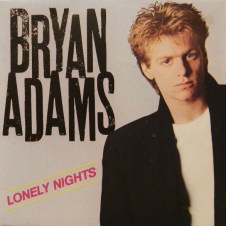 I had discovered Adams on a bus going downtown in Vancouver sometime in 1981. I was listening to CFOX on some strange FM-only portable radio when “Lonely Nights” came on: I was floored. I loved the shimmery lead guitar, what would become Adam’s signature crunchy rhythm guitar, and the tune. I immediately went downtown and picked up You Want It, You Got It. Side One of the album still blows me away: “Lonely Nights,” “One Good Reason,” “Don’t Look Now,” “Coming Home,” and “Fits Ya Good” – I could (and did) play it over and over. It remains my favourite Adam’s album (and my 16-year-old self did find Adam’s cover shot pretty cute). Cuts Like a Knife also had so many great tunes, though I would single out “This Time” as a pretty perfect poprock single. Reckless would be Adams’ masterpiece with nary a false move. Its key single, “Run to You,” is as good as poprock gets, a remarkable bit of songwriting, production, and arrangement. The atmospheric keyboard backdrop and ringing guitar lines alone are worth the price of the album.
 … and you’re sitting, well, not on top of the world, but somewhere – interesting. Since 2004 California’s Rogue Wave have been releasing albums that tweak and redirect that state’s peculiar dream-state, inviting a melancholy re-assessment of life and the act of living it. Their 2005 single “Publish My Love” stood out from the pack of bands peddling acoustic-guitar based, pleasant-sounding pop songs for its starkly original sound: all the classic poprock motifs were there but somehow Rogue Wave put it together in a distinctive way.
 Their new release is the whimsically-titled Delusions of Grand Fur and it reproduces all that the band excels at: highly textured production, a solid bed of acoustic guitars, creative instrumentation, and catchy tunes made more interesting by inventive vocal and percussion arrangements. Highlights include “In the Morning,” “Look at Me,” and the stunning, stand-out single, “California Bride” with its shimmering guitars and dreamy vocals.
 Free Energy have a number irresistible singles across their two albums and EP. Things started off well with their debut song “Free Energy.” There is something audacious and mildly amusing about forcing deejays to say ‘here’s “Free Energy” by Free Energy!’ Say what? Even before they got their own material out, they had a killer cover of Springsteen’s “I’m Going Down.” Their 2010 debut album Stuck on Nothing channels a mixture of Bachman Turner Overdrive riffing with 1980s pop song sensibilities. “Light Love” has it all – swirling, candy-coated guitar sounds, fattened up vocals, and some great slow burn hooks. 2013’s Love Sign offers up more of the same, along with a few more languid pop gems, like “Dance All Night.” Free Energy are like a retro-1980s dance party band, but with fresh material. Since 2013, things have slowed considerably for the band, with some solo material from various band members emerging. However, their Facebook page did recently indicate that more would be coming from this band.
 September 2012 I casually checked out something called iTunes Festival on the Apple TV home screen and accidentally discovered Jake Bugg. The feeling was electric. Kinda like when I saw Tracy Chapman open for John Martyn in Manchester in 1988 three months before her breakthrough appearance at the Nelson Mandela concert at Wembley Stadium in London – everyone in that northern club knew we had just seen a major talent. Bugg’s debut album came out in October and it did not disappoint. Everything that made his iTunes performance amazing was there. Shockingly, the album opened at number one on the British charts.
 Many have written about Jake Bugg’s youth, his songs, guitar playing, and singing style, but what struck me as special about Bugg was his authenticity. His songs were all about working class life in middling England in the new millennium, something overlooked in most of popular culture. Indeed, the absence of any cultural mirror for the experiences of working class youth in most western countries makes the occasional mention stand out in stark relief. Bugg’s debut album gave voice to a generation left behind by the economy and the political class in songs like “Two Fingers,” “Seen It All,” and “Trouble Town.” Sure, some fans and music writers just listened esthetically, hearing the folk, folk blues, and rudimentary rock and roll sound, but the ability to speak authentically about his community’s class experience touched a nerve for those who were listening. However, after touring with the album for over a year, Bugg told journalists he doubted he could write about such experiences anymore because his life had changed so much.
 Bugg’s new album, On My One, is almost out and it appears to be similar to and different from his earlier material. The social themes remain but he pushes himself artistically into new genres. Growing up in the new century nobody consumes just one style of music so it was hardly surprising that Bugg’s talent could not be contained in just a few styles. “On My One” evokes the lonely solo acoustic guitar sound of Don McLean’s American Pie album, specifically “Vincent” and “Till Tomorrow,” while drawing from Bugg’s experience as a performer on tour. “Love, Hope and Misery” confirms Bugg’s talent for remaking the American blues ballad in his own style. But my favourite amongst the currently available selections from the record is “Bitter Salt,” a song unlike anything Bugg has done to date, a catchy poprock effort with a punchy arrangement and solid hooks.
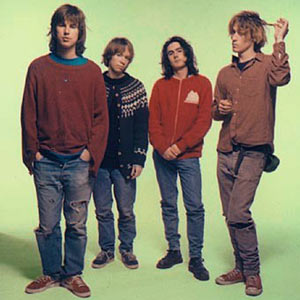 Back in 1996 I got my copy of One Chord to Another and thought it was pretty cool, but frankly I was a bit distracted. I didn’t give it the worship it deserved. Reviewing it now I can better appreciate how this band had it all going on – great sound, solid hooks, and a palpable authenticity. How did Nova Scotia produce such a monster act? Their first EP Peppermint and full length album Smeared had a great indie sound, with both versions of “Underwhelmed” worth hitting repeat on. But their first major label effort, 1994’s Twice Removed, announced the arrival of a polished and original musical force, with “Penpals” a great weird single. Then they turned around and dumped their major label (Geffen) and turned out another great record, 1996’s One Chord to Another, spending one-tenth the budget of the previous one. While the album is bursting with great tracks, I’m partial to the very Beatle-esque “The Lines You Amend.” Talk was, Sloan would be the next big thing worldwide. But things didn’t really pan out that way.
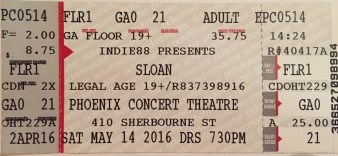 Earlier this month I saw Sloan play One Chord to Another in its entirety at the Phoenix in Toronto as part of 20th anniversary tour commemorating the album. The show was broken into two sets, with the first blasting through OCTA and the second drawing from their other ten albums. Despite owning three of their records, I couldn’t name a single tune, though their audience was pretty well informed, drowning out the band on a few sing-a-longs. After such an amazing show, I decided to school myself on all things Sloan. Was this a band just reliving the glory of a few early records? After reviewing their catalogue, I can honestly say ‘no’. If anything, Sloan’s records only improve over time as the band expands its sonic range and songwriting scope. And that is saying something because those early records – Smeared, Twice Removed, One Chord to Another, Navy Blues – showcase the signature early sound of Sloan where the vocals and guitars slide together into a great sonic mash of hook-laden tunes. But, I will have you believe, their later material is even better.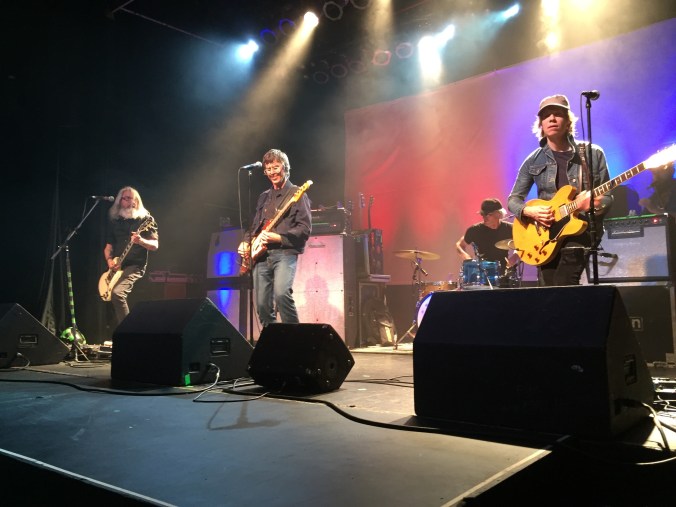
 Victoria’s Sam Weber has material that sounds deceptively simple but there is significant depth to his songs: subtle hooks, sophisticated production, and great arrangements. His 2014’s debut album, Shadows in the Road, has so many great songs it is hard to showcase just a few. Certainly “Right Hearted” has to be singled out as the obvious radio single. While the intro might be a little long, when the acoustic guitar kicks in the song takes off, stratospherically so when the keyboard appears at the 1:17 point. There is a very Sam Roberts feel to the hooks and chorus.Right Hearted
 Sam Weber and band appearing live in a Toronto living room, May 2016.
 Linus of Hollywood, stage name for Los Angeles musical polymath Kevin Dotson, has distilled a unique blend of 1960s/1970s influenced poprock on his four albums and various singles since 1999. And he has a voice that is often a dead ringer for Squeeze frontman Glen Tilbrook. The album catalogue might look a bit thin, but that’s just because he’s in such constant demand to do music for television and movies and produce and write songs for other people’s records to pay the bills. But what he has managed to put out is quality stuff, fully deserving of stratospheric success.
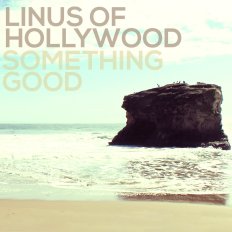 All that went before was enjoyable but 2014’s Something Good takes Linus of Hollywood’s performance to a new level. As
  “David Newberry sings folk music with rock sensibilities. Or is it the other way around?”
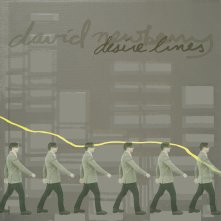 Casting back through Newberry’s catalogue there are so many great songs, ones that touch on both the personal and political. I am partial to “4th Fret” and “The End” from When We Learn the Things We Need to Learn and “Easter” and “English Bay” from No One Will Remember You. But his 2014 EP Desire Lines definitely represents a shift in approach – now the record seems more than just a collection of songs and Newberry is clearly experimenting with his sound and image. Listen to these two starkly different treatments of his song “Slow”: one draws from his folkie electric esthetic while the other is a full blown poprock song. Personally, I think the latter has got hit single written all over it.
 If Desire Lines and the radio edit of “Slow” represented a boundary-testing bit of experimentation, then 2015’s Replacement Things comes on like a new, more comfortable synthesis of his many influences. This is a solid record with great songs and a coherent, unique sound. Littered with references to his sometime Vancouver home, I’d have to call out “Coyote,” “Shiny Pretty Things,” and the haunting “Freddy Mercury” as my stand-out tracks.
