
Tags
Bruno Gerussi, Bruno Gerussi's Medallion, Gene Clark, Ginger's Alright, Guitar Damage, In Search of the Fourth Chord, Kinks, Little Games, Muswell Hill Ray, Picture Book, So You Say You Lost Your Baby, Sometimes Good Guys Don't Wear White, Tell Me What You Found
 In the late 1980s and early 1990s I had the pleasure of acting as a roadie of sorts for a guitar-god friend of mine whose band had a brief blast of Canadian music fame. Bruno Gerussi’s Medallion was the brainchild of Vancouver Province rock writer Tom Harrison, an outlet for his love of 1960s garage rock and various forms of 1970s alternative rock and roll. In 1989 they were signed to WEA Canada and released one album, In Search of the Fourth Chord.
 They took their name from Canadian actor Bruno Gerussi, who starred for 18 years as Nick Adonidas, a beachcomber on British Columbia’s coastline in one of the Canadian Broadcasting Corporation’s most successful shows, The Beachcombers. At the same time he hosted a cooking show where he would wear a very large medallion around his neck, thus the name of the band. I was at the show at the Town Pump in Vancouver where Nick actually met the band and heard some of their music. I’m not sure it was really his style. As a band, BGM showcased all the classic 1960s and 1970s underground sounds but, frankly, sounded too good to be garage rock and too polished to be punk, while Tom’s singing was more like talking. Reading the liner notes for BGM’s sole album, the record sounds surprisingly coherent given the changing line-up of players. In terms of songs, both “Ginger’s Alright” and “Tell Me What You Found” stand out for me, the former for the tune and the latter for the musical arrangement. Ginger’s Alright Tell Me What You Found
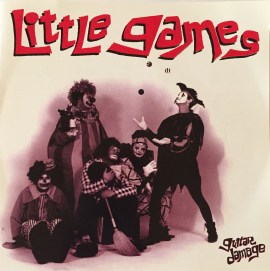 BGM eventually morphed into Little Games, a moniker taken from the Yardbirds’ record of the same name. However, their recording contract with WEA lapsed and Little Games’ only record, Guitar Damage, would be released on the band’s own BGM Record label. And that was a shame, because in so many ways Guitar Damage was a more solid record. For instance, unlike BGM, Little Games had a stable line-up of players, Tom was actually singing more than just talking his way through the songs, and the song selection itself was strong in terms of covers and original material. I particularly liked the band’s composition “Muswell Hill Ray,” a name-dropping tribute to songs by the Kinks’ Ray Davies, as well as their cover of the Standells’ garage rock classic, “Sometimes Good Guys Don’t Wear White.” Muswell Hill RaySometimes Good Guys Don’t Wear White
But the standout track is the band’s amazing cover of Gene Clark’s “So You Say You Lost Your Baby.” The song should have been a big hit by the Byrds, but as Clark had just left the band in 1967 he recorded it himself on his first solo record in what was a rather lacklustre, singer/songwriter treatment. Subsequent covers rocked it up a bit but didn’t really capture its greatness. But the version on Guitar Damage rightly recasts the song back into a 1966-era Bryds register, complete with ringing Rickenbacker electric twelve-string guitar. The song shimmers with lead guitar player Jimmy Walker’s solid playing – it is also Tom’s most accomplished, confident performance as a vocalist. Sadly, this was a band really coming into its own as performers at the very moment their career trajectory stalled.So You Say You Lost Your Baby
Today some of the band’s BGM-era catalogue is available online while the Little Games material is harder to find. The band also did a killer live version of the Kink’s “Picture Book,” which might be available on their hard to find live recording. I also took a number of pictures of the band from various shows, which ended up in singer Tom Harrison’s possession but have not surfaced. A proper online retrospective of the two bands’ accomplishments remains largely unavailable, though some information can be found on Harrison’s website.
 My new favourite music blog,
 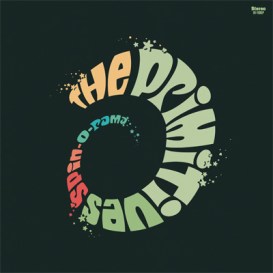 But Spin-O-Rama, released in 2014, marked the return of the Primitives in all their glory. Roughly 30 minutes of all-new, original material in their signature chimey-guitar and reverby vocal style – it was like they never left. The opening track is the album’s title track: “Spin-O-Rama” is a classic Primitives’ arrangement featuring trebly solo guitar and a feel that is reminiscent of the 1960s without being reduced to it. A great single! Other strong, single-like songs include “Lose the Reason” (with vocals from both Tracy and Paul), “Petals” (which sounds like it fell off the running order of either of the first two albums), and “Dandelion Seed.” Other highlights include “Follow the Sun Down,” with its great chunky 60s vibe, and “Working Isn’t Working,” a droll response to the drudgery of conventional work, sung by Paul. Primitives’ albums always featured a song or two sung by Paul but Spin-O-Rama increases the ratio: of the 11 songs here, Paul sings solo on three and with Tracy on two. Additionally, Paul also sings on the extra track paired with the single “Spin-O-Rama,” “Up So High,” which is driven by a fantastic buzzy guitar sound. The album wraps up with an altered reprise of the title track in “Let’s Go Round Again.” It is refreshing to have such a great band return to active duty in top form. The Primitives’ Spin-O-Rama does not disappoint. Keep up with the Primitives on their
  I was one of those armchair parents with all the answers about how to bring up children before I was actually responsible for any. But parenting is more exhausting, exhilarating and unpredictable than anything I have ever done. Nobody really admits how complicated raising kids can be. Nor are we very honest about what childhood is really like for either the kids or the parents, as most accounts are either cloaked in denial or sentimentality. When it comes to music, songs about kids are some of the worst. Happily, the four songs featured here either commit to having fun, being not that serious, or do something unusual.
 A statement that seems as obvious today as when Bacharach and David wrote it in 1965. As the crushing weight of refugees from the world’s war zones threatens to overwhelm the goodwill of the West’s welfare states, we need love to help find a safe space for the displaced of our times, the children, their parents, and those without family or friends. Our three contributions focus on that ever so scarce commodity that cannot really be priced: love.
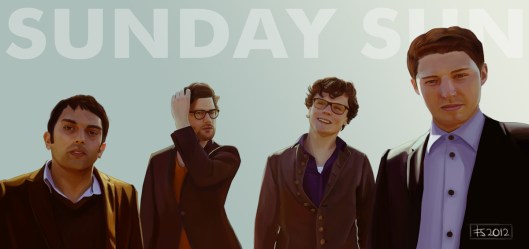 Sunday Sun capture the pure joy that can be the best of poprock. Their songs often have an uplifting quality that encourages repeat listening. I have had this reaction before, like the first time I heard “One Step Ahead” by Split Enz or “Another Nail in My Heart” by Squeeze or “Teacher Teacher” by Rockpile. I just couldn’t wait to hear them again.
 Public Access TV is a band in the process of coming into its own. Released less than a year ago, their first EP, Public Access, was great, featuring strong tracks like “Patti Peru,” “Metropolis,” and “Loose Ends” (with its great loopy piano solo). But starting with last November’s single “In Love and I’m Alone” the band really began to carve out a distinctive sound, which is reinforced with the first single from their forthcoming album: “On Location.” Public Access TV come to Toronto May 6 to play the
 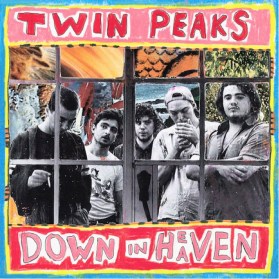 Twin Peaks looks like a band of stoner dudes, ready to party anywhere. But their music is not the spaced-out stoner jams of yesteryear. This is a rock and roll outfit whose material stretches from the buzzed out vocals of “Baby Blue” to the garage rock vibe of “In the Morning (In the Evening)” to the dirty power pop of “Flavor” to the crisp poprock production of “Telephone.” But they have outdone themselves on their new single “Walk to the One You Love.” This song is sonically more sophisticated and professional than anything they have ever done. The band owns this tune, riding a catchy guitar riff, mixing in great vocals, horns and piano. All this bodes well for their soon-to-be-released new album, Down in Heaven.
 There are a lot of bands named Swerve. This one is a California band that channels the great poprock sound of those mid-1980s Athens, Georgia, post-new wave acts. Even their smoldering cover boy above exudes 1980s angst, or is that just a chill in the air? It was hard to choose just one song from the Swerve’s recently released self-titled EP. “Aw Hell,” “You’re Wild,” and “Baby Blue” all have single written all over them but this time I’m going with “Remedy” which kicks off with a great wall of guitar before going a bit quiet and then coming back in strong on the chorus.
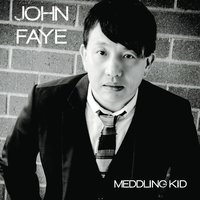 John Faye is no newcomer to the music scene. He was for many years the creative force behind IKE, which had a number of hits. But if you’re familiar with his past work, you will hardly recognize him from this new solo album, Meddling Kid. On this new effort, he has traded in the FM radio rock sound for a more poprock palette. Highlights for me include “Meddling Kids,” “Into Philadelphia,” and our featured track, “Keep On Hanging Around.” The song builds masterfully from a simple acoustic guitar opening verse to then fatten up the vocals and introduce more of the band and electric guitar in a way that hooks the listener in. A ‘how to’ of great poprock production.
 Poprock Record