Tags
Field Day, Marshall Crenshaw, Marti Jones, Michael Fiore, Ronnie Spector, The Kavanaghs, Whenever You're On My Mind, Zach Jones

With just five songs featured on this post it may appear to be an abbreviated episode of Cover Me! but I still think it’s worth your while stopping by. “Whenever You’re On My Mind” is one of my all-time favourite songs. For me, there’s just no way anyone is going to touch the transcendent beauty of Crenshaw’s original. Initially recorded during sessions for his debut album, the song didn’t quite fit and ended up the lead single on his fabulous second LP Field Day. Talk about making a good first impression, the track opens the album with one of the most seductive guitar hooks of all time, the vocals are a master class in power pop elocution, and the production is so brilliantly, sibilantly Steve Lillywhite good. Frankly, running the search engines on YouTube, Bandcamp and iTunes, it doesn’t appear that a lot of people have been up for the challenge of covering such a formidable composition and performance. But there have been a few worthy attempts.
We start with Marshall, of course. For a different take from the single and album cut you can find a live version of “Whenever You’re On My Mind” on his 2021 collection The Wild Exciting Sounds of Marshall Crenshaw. The 1983 video for the song is worth a viewing too, if only for its time capsule feel for an early 1980s look and ambience.
In terms of covers, we begin with the most inventive. Working with REM producer Don Dixon, Marti Jones put out a number of albums in the 1980s that saw her put her stamp on a host of songs from the likes of Elvis Costello, Dwight Twilley, David Bowie, and John Hiatt. Her cover of “Whenever You’re On My Mind” appeared on her 1986 album Match Game, which Marshall Crenshaw played some 12 string guitar on, though not on his song. What is striking on her cover is how she changes the vocal emphasis on the lines in the chorus. Girl group legend Ronnie Spector did a whole EP of Marshall songs on 2003’s Something’s On My Mind. She too added a few surprising twists and turns to the song’s melodic arc here and there that really work. I only know Zach Jones from his spot-on Monkees reincarnation track from 2020 “Must Be On My Way.” His 2016 acoustic approach to covering “Whenever You’re On My Mind” lightens the power pop intensity, gentling the vocals and guitar attack. The effect is reassuring rather than bracing. I really like the guitar tone and ramshackle vocal on Michael Fiore’s cover from the same year. There’s a rehearsal space Replacements vibe to this rendition. The Kavanaghs hail from Rosario, Argentina and put Marshall’s song on the b-side of their 2021 single “Going To The Beach.” The latter is more of a vamp-ish rocker so their cover shows they can’t handle the more melodic side of the street too. Why more people don’t cover MC is a mystery to me, given the results on display here with just these five submissions.
Need more Marshall? Who doesn’t. Get on over to marshallcrenshaw.com to find your Marshall merch, show tix, latest news and records.
 Marshall Crenshaw has long been my fave solo artist. Why MC? Maybe it was the glasses – he looked kinda smart and rock and roll. But what first caught my attention was the 1000 watt hook lighting up Field Day’s first single, “Whenever You’re on My Mind.” Has anyone recorded a more perfect seven seconds of poprock intro? I don’t think so. But then I’ve always been a sucker for a stunning lead guitar line – stuff like the Beatles’ “I Feel Fine” and “Day Tripper” or the Church’s “Unguarded Moment” and Big Country’s “In a Big Country.” But it’s more than just hooks that makes Crenshaw a poprock legend, there’s something about his songs that can always toggle the joy and an involuntary smile from me. And it’s all there with his combination of 1950s Buddy Holly and Everly’s roots, Beatlesque melodies and a 1980s new wave/indie delivery.
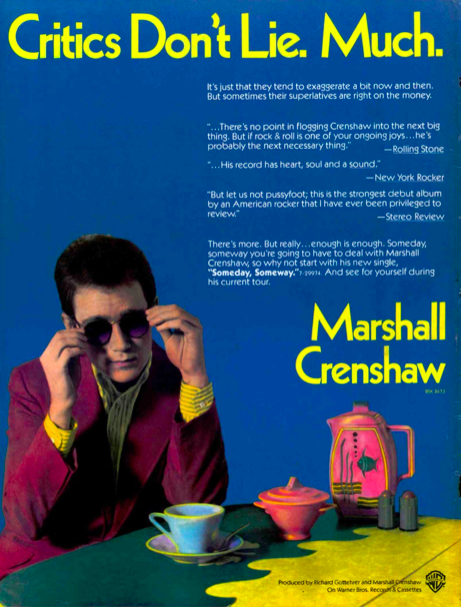 With ten albums, six EPs, and a host of one-off singles, compilation contributions and covers there’s plenty of Crenshaw to choose from. What follows is just my whirlwind and idiosyncratic take on a pretty fabulous and inventive career. Now to begin, let’s be clear that MC’s first two albums, the self-titled Marshall Crenshaw and Field Day, are pretty much poprock perfection. I shouldn’t single anything out – these records are nonstop ear candy. I’ll say this much, you can dance to “She Can’t Dance” while “One Day With You” is a masterclass in melodic songcraft. Funny, though I first heard MC via Field Day’s initial single, I didn’t pick up the album until years later. Problem was, as an older release (by one year when I first heard it!) the damn record never went on sale at my local retailer.
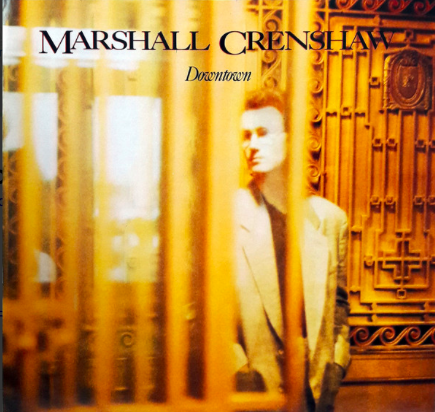 The first Crenshaw album I really got into in real time (i.e. when it was released) was Downtown and it remains my favourite, mostly for sentimental reasons. I bought it and played it non-stop in my first one-room apartment in Vancouver’s West End. It was both a declaration of adult independence and – thematically, with its retro 1960s Warner Brothers vibe – a strong link to my parents’ record collection. The album rocks on tracks like “Right Now,” “Little Wild One,” “Terrifying Love,” and “(We’re Gonna) Shake Up Their Minds” while Everly-ing the hell out of “Vague Memory” and “Lesson Number One.”
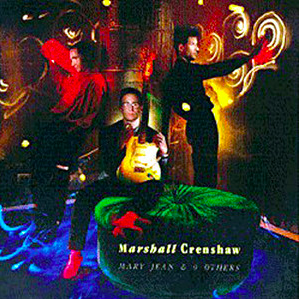 From then on I’ve pretty much picked up every EC release as soon as they hit the shelves and never been disappointed. If you’re just starting out, here would be my picks from each to get you into the groove. From 1987’s Mary Jean & 9 Others I’d drop the needle on “Mary Jean” and “Calling Out for Love at Crying Time.” You really get a sense of Crenshaw’s mastery of the hooky lead line here. 1989’s Good Evening is hard to make choices over given its exquisite, dynamic mix of originals and covers. Personally I love “Someplace Love Can’t Find Me,” “She Hates to Go Home,” and “On the Run” but really I feel like I’m choosing which limb to hack off because every song here is pretty special. In 1991 MC left Warners for MCA with Life’s Too Short. In interviews for the record Crenshaw talked about the work he put into extending his guitar technique and it showed on should-be hit singles like “Delilah,” “Fantastic Planet of Love,” and “Don’t Disappear Now.”
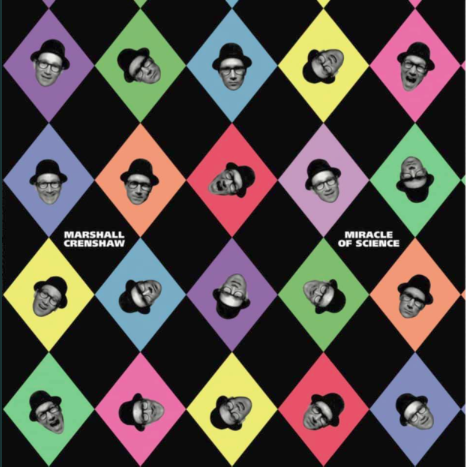 And then Crenshaw left the major label scene altogether for the relative freedom of more independent releases, first with Razor and Tie and then with his own 429 Records. Since then he’s moved in some new directions musically but always offered up some melodic poprock gems, like “What Do You Dream Of?” and “Starless Summer Sky” from 1996’s Miracle of Science, or “Television Light” and “Right There in Front of Me” from 1999’s #447. In the new millennium there’s been “A Few Thousand Days Ago” from 2003’s What’s in the Bag? and “Long Hard Road” from 2009’s Jaggedland. #395 is MC’s EP collection from 2015, a kind of quasi-album at 14 tracks, and it sees Crenshaw back in excellent form with “Moving Now,” “Front Page News,” and a killer Bobby Fuller cover “Never to be Forgotten.”
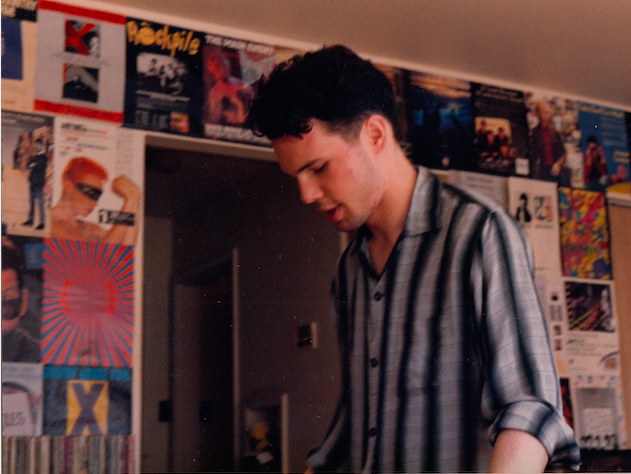 Just to prove my MC cred, here’s snap from my past featuring my unique bachelor apartment decor! Ok, this is actually my second apartment (circa 1987) but if you look up in the far right corner, you’ll see the Billboard magazine ad/poster for MC’s debut LP that appears above on the wall! Photo credit: James Koester.
 Poprock Record