
Jean Caffeine is an American indie treasure. Over her long career she’s hit all the alternative scenes: punk in seventies San Francisco, no wave in New York City, Americana in Austin, and a decidedly more poprock feel on recent albums (Love. What Is It?) and singles (“I Don’t Want To Kill You Anymore”). She’s a clear manifestation of the positive dialectic between artist and scene. Now she’s got a new LP Jean Caffeine Generation ready and it is a heady mix of social commentary, heartbreak and hooks to spare. Following recent music distribution trends, she’s drip released most of these songs already as singles but somehow they still manage to cohere together as an album. I’ve reviewed most of the material already over the past year or so, comparing her to the likes of Patti Smith, Mary Lou Lord, Amy Rigby, Robin Lane, Marti Jones, and Chrissie Hynde. And I stand by those assessments. But listening to the songs as an LP Caffeine’s own distinctive voice really comes through, one part all rock and roll heft, the other emotional pop vulnerability.
Album opener song “Love What Is It?” is a poppy saunter in the park, adorned with melodic asides that seem thrown in but land perfectly. At various points it really reminds me of Marti Jones or Aimee Mann. Then comes “Big Picture,” a track that hasn’t appeared anywhere and it’s a hooky winner. “I Always Cry on Thursday” starts so nondescript but the chorus breaks out with a melodic intensity that is irresistible. Crying also features on “Another Crying Christmas,” a track that avoids the seasonal saccharine by dialing into some emotional depth and rock and roll edginess. “I Know You Know I Know” uses verbal repetition and a 1980s computer game keyboard tone to draw you right in. What I hear on “Circuitous Routes” is a cool strut, so Chrissie Hynde. I also appreciate Caffeine’s deft ability to weave political themes into her work without sacrificing their ear-worminess. “I Don’t Want To Kill You Anymore” is so brilliantly understated, a slow-groove girl-group homage that’s a far cry from “He Hit Me (And It Felt Like a Kiss).” And it takes a rare talent to make “Mammogram” a winning tune. Caffeine’s cover of The Who’s “The Kids Are Alright” is just ramshackle fun. A bit of performance art closes things out on “You’re Fine.” You don’t spend time in NYC’s 1980s art ghettos and not catch the bug.
Jean Caffeine is a product of her era, from youthful punk to senior songstress. But generating Jean didn’t just happen. Spend some time with Jean Caffeine Generation to get a sense of her genius at work.
 It’s a man’s, man’s, man’s, man’s world they tell us and nowhere is that more true than in rock and roll. The omniscient perspective in a rock song is usually male, with a few exceptions. But to the music scene’s credit, more women have been making inroads over the past two decades or so. The first woman I recall identifying not simply as a ‘female vocalist’ but as a universal rock voice was Chrissie Hynde of the Pretenders. Since then the indie scene has provided us with a number of examples of larger than life female artists (they have to be to crowd out the men) with great songs and powerful performances.
 Jill Sobule has had an amazing career doing, apparently, pretty much whatever she has wanted to do. After a false start at Geffen in 1990, 1995’s self-titled Jill Sobule set the frame for what would follow: a quirky, often folky, sometimes hilarious, always introspective and keenly observational singer-songwriter that has consistently produced great albums. Kinda like a rock and roll Suzanne Vega, but with more ‘tude. Threaded throughout her work is a strong set of political and feminist commitments, ranging from the satirical “Supermodel” to the more recent “Women of Industry.” Sobule’s catalogue is an embarrassment of riches so here’s an almost random selection. “Supermodel” showcases the uptempo hit songwriter, “Bitter” from 1997’s Happy Town rides a perfect hook, “Rock Me to Sleep” from 2000’s Pink Pearl exemplifies her tender side, while the banjo-driven “Old Kentucky” from 2014’s Dottie’s Charms is just a bit of rollicking fun. Sobule is working on a new album now and you check out her Soundcloud
 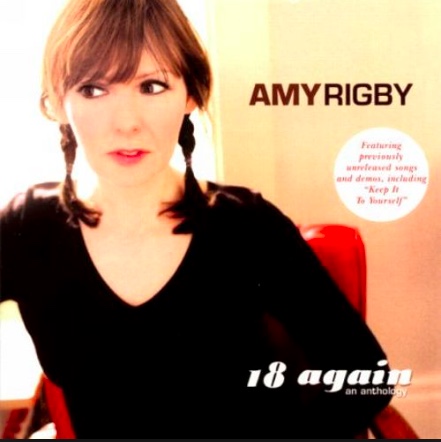 There are times when Amy Rigby seems so country. It’s there in her voice, that weary 1960s sound of oppressed Nashville womenhood. But then the angle shifts and the rock and roll dynamo shows through, giving voice to a whole lot of gendered working class experience from a lifetime of surviving the independent music scene. Her 1996 solo debut Diary of a Mod Housewife was a masterpiece of melodic social commentary but it didn’t lead to explosive sales. Since then, Rigby has continued to release solid records with songs that draw on all manner of classic rock and roll motifs, while giving voice to issues of class, relationships, gender and aging. A good place to start would be her 2002 compilation 18 Again. There you can check out the perfect 1960s elan of “All I Want” or the new wave vibe to “The Good Girls” or the masterful turns of phrase on the acoustic “Magicians.” Of course, I would add a few songs from 2003’s Til the Wheels Fall Off like the age-conscious “Shopping Around” or “Last Request” as well as 2005’s Little Fugitive,which contains a host of beautiful song scenarios like “The Trouble with Jeanie” and “Dancing with Joey Ramone.” She is back this year with Old Guys, where I’m digging “Are We Still There Yet.”
 So much has been written about Juliana Hatfield and her many impressive accomplishments, all the great bands she has been part of, there’s really not much I could add. So I’ll just focus my attention on her continuing strength as a songwriter and recording artist. After a break of 22 years, her reunited Juliana Hatfield Three released a killer album in 2015, Whatever, My Love, with radio-friendly single material like “Invisible” and “If I Could.” Deep cut fave – “Parking Lots” with it’s sunny subtle hooks. Then in 2017 she released the dynamite, politically-charged solo album, Pussycat, a reaction to the election of Donald Trump. Here I would single out the jaunty “You’re Breaking my Heart” and “Kellyanne.” Then, as a reaction to the previous election year’s constant negativity, Hatfield decided to release an album of Olivia Newton-John covers. Here she works a creative tension between mirroring and reinventing the originals, with particular success on the Xanadu sountrack numbers, in my view. “Magic” amps up the early 1980s keyboard sound and adds Hatfield’s own distinctive vocal approach. Juliana Hatfield Sings Olivia Newton-John is better than cover albums are allowed to be, a real treat.
 Ever since Bonnie Jo Mason first warbled “Ringo, I Love You” back in 1964 there’s been a regular outpouring of musical love for the famous. Some serious, most not, with a great deal of it amounting to little more than hopeful AM radio opportunism. Some are so clever, you can’t tell if the songs are sincere or mockery. Nick Lowe produced a lovely tongue-in-cheek tribute to one uber-famous teen sensation in the 1970s with his “Bay City Rollers, We Love You,” though, tellingly, he kept his name off the 45 (it was credited to the Tartan Horde). But another approach combines genuine admiration with a proper sense of fun. After all, loving the famous shouldn’t be taken too seriously!
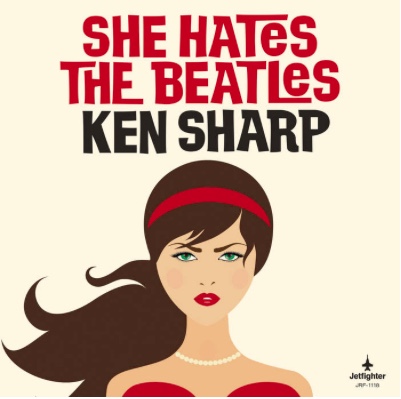 I got started on this theme after hearing Ken Sharp’s fab new single, “She Hates the Beatles,” thinking I could whip up a post focusing on songs about the Beatles. But that went bust quickly. There weren’t that many songs, surprisingly, with most of the good ones written by ex-Beatles themselves! Heading back to the thematic drawing board, I decided to broaden the focus to include songs about the musically famous more generally, stopping short of Beethoven. Now I could gather a solid handful of tunes. Sharp led the pack with his aforementioned new single.
 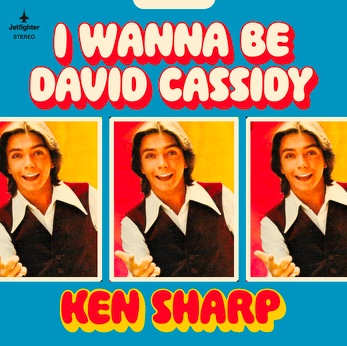 This guy is one impressive dude: longtime music journalist, author of numerous books on great musical acts, and a not too shabby songwriter and performer. “She Hates the Beatles” is the product of challenge from producer Fernando Perdomo, who provided the title and push to turn it into a song. The result is a wonderful, definitely Beatlesque, pop song. The only real concern here is how the protagonist got into this clearly doomed relationship at all! Sharp also secured our number two position with his hooky homage to David Cassidy on “I Wanna Be David Cassidy.” This single hits all the Partridge Family marks, maybe better than the original. The amazing of-the-period-style artwork on these two singles is also worth mentioning.
 Poprock Record