Patrick Donders over at the Sweet Sweet Music interview blog put me on to Germany’s Usedand their recent sprawling double album-equivalent Sensationalize record. From the LP’s 18 tracks the band are currently promoting “Eleven Days” and “Take the Pain Away” as videos, both great songs worthy of singling out. But my own reading of the stand-out, should-be hit single from this collection is without question “Morning Sun.” The song crackles with energy from the outset, constantly shifting musical ground with clean and striking Beatlesque lead guitar work, hair-raising vocal harmonies, and an arrangement that is pop genius. While not sounding exactly like anybody else the sonic atmosphere brings to mind acts like Sunday Sun, Golden Seals, and Telekinesis for me.
Morning Sun
Now, if I may be so bold, every great 45 A side should have a complementary B side, something recognizably in the same register but with a different attack or leaning on different instrumental choices. Here I think “Seagull Island” strikes the right chord (literally), replacing the A side’s manic pacing with a more languid, Fountains of Wayne kind of melodic ennui.
Seagull Island
Used’s new LP Sensationalize is a lot to take in and enjoy. So start here and then travel on the band’s website to find out more. And for some unique acoustic, live-in-the-record store versions of these songs, check out the band’s YouTube page.
I grew up immersed in popular music. My parents were barely adults themselves when they had me and my other brother and their enthusiasm for the 1960s music scene they were living through was palpable. If the TV was off the record player was on. Between them my parents covered a pretty wide swathe of the popular music scene. Dad was everything from Elvis, Jerry Lee Lewis and Chuck Berry right through to Jimi Hendrix and Creedence Clearwater Revival. Mother filled in more of the pop content with Buddy Holly, Brenda Lee, and Gene Pitney as well as country like Patsy Cline and folk from Pete Seeger. And they both loved The Beatles. This was the musical universe I came from as I began exploring music on my own in the mid-to-late 1970s. I picked up a few things from AM radio – thank you LG73 for playing Rockpile and Squeeze! But for years I struggled just to find out about music. I wish I had something like S.W. Lauden’s fabulous music review site Remember the Lightning back then. It would have made getting where I am now a lot easier.
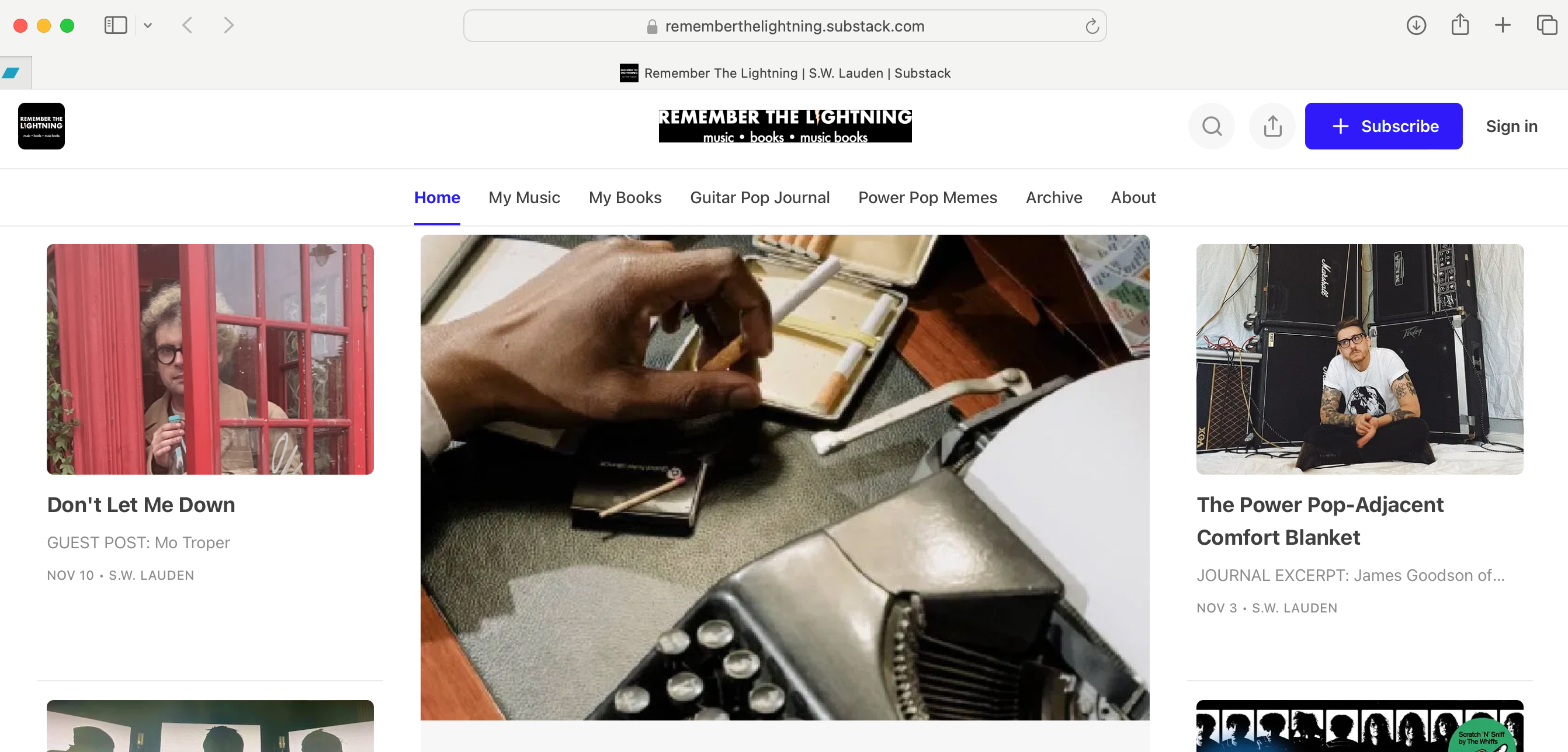
S.W. Lauden is a music book editor, essayist, novelist, and drummer with bands like Tsar and The Brothers Steve. He is also the driving force behind Remember the Lightning, a website and semi-annual music journal focusing on the micro sub-genre of rock and roll known as power pop. Subtitled ‘A Guitar Pop Journal,’ Remember the Lightning takes its name from a 1979 song by a band called 20/20. And that’s important because 1979 was arguably a seminal year for the power pop genre, witnessing an explosion of melodic rock bands that followed in the wake of punk’s destabilization of the era’s whole rock and roll scene. Since that early but brief high-point power pop has remained on the margins of the more commercially successful music world, occasionally producing a break-out hit (“Stacey’s Mom” anyone?) but mostly surviving as a niche amongst a strongly loyal fan base. Lauden hopes to contribute something to changing that with his journalistic efforts on Remember the Lightning. By bringing together a unique mix of musicians and fans in each issue, the point is to convey some of the excitement and joy that drives the genre and helps explain its staying power despite a failure to storm the charts. And perhaps bring about some chart-storming.
Let’s talk about what Remember the Lightening is not. Despite the subtitle describing it as a ‘journal’ it is not academic in its approach. For a long time, ever since the Frankfurt school dumped all over popular music back in the 1940s, academe had a strained relationship with what the young folks like. But that began changing as boomers moved from attending the concerts to writing about them. Now there are a host of academic spaces where one can dive into ‘Beatles Studies’ or publish in The Journal of Popular Music and Society. No, this journal is more immediate, less detached than the kind of stuff academics produce. It’s about what bands and fans are into now: what they’re doing, why they’re doing, who inspired them, and whether audiences will dig the whole thing. Issue #1 that came out earlier this year lays it all out with ruminations on the genre, reflections on influential songs, and plenty of writing by and about the artists, both newbies and veterans. The range of covered acts includes the Beths, Exploding Hearts, Whiffs, Sloan, Juniper, Popsicko and Tinted Windows. Issue #2 is just out and it’s even more ambitious, with coverage of historic power pop music scenes (Philadephia), a primer on southeast Asian guitar pop, classic bands (The Replacements) and albums (Welcome Interstate Managers), musician autobiography (Kurt Baker), and great new albums from the Uni Boys and Kate Clover.
I had to find my music resources the hard way, e.g. by hosting a college radio show at the crack of dawn on Saturday mornings in the 1980s or buying countless reference books like The Trouser Press Record Guide and Joel Whitburn’s Top Pop Singles. Today’s internet makes things much easier for power pop kids to find their peeps. Give yourself a break and ‘go all the way’ to the hyperlinked web address for Remember the Lightning. Your power pop community awaits.
On the blogosphere there is already a clearly demarked niche music genre that combines melodic pop melodies with the classic rock and roll combo of electric guitars, bass and drums: power pop. Said to have been coined by no less an authority than Pete Townsend of The Who, the term ‘power pop’ is now applied to any band with jangly guitars, swooping background harmonies, and a strong melodic hook. My blogroll features two such sites (Absolute Powerpop and Powerpopaholic) and there are many more. So why cast my efforts under a different label like poprock? Well, simply put, I think poprock is a broader, more inclusive term. Or, to put it another way, while all of power pop could be considered a form of poprock, not all poprock would be characterized as power pop.
For many bloggers, power pop has become a kind of music esthetic: a certain kind of guitar sound, a particular combination of instruments and vocals, etc. Poprock, by contrast, is less rigid. It is less a genre than a sensibility, crossing over different styles. Sure it is defined by strong melodies and as a category it would make little sense if it didn’t relate to the rock and roll cannon. But rock and roll itself was a bastard child of multiple influences: south Chicago electric blues, Appalachian mountain fiddle solos and harmony vocals, western swing, and so on. What differentiates its many sub-genres is the balance of influences. Thus poprock takes a bit more of the swing and country than the blues while still set within the classic rock and roll combo. Here I’m thinking of Buddy Holly, the Beatles, the Steve Miller band (in the hits era), Marshall Crenshaw, The Smithereens, and, more recently, Bleachers.
So don’t get me wrong – I love power pop. It’s just that I like a lot of other things too.Bleachers website
 Poprock Record