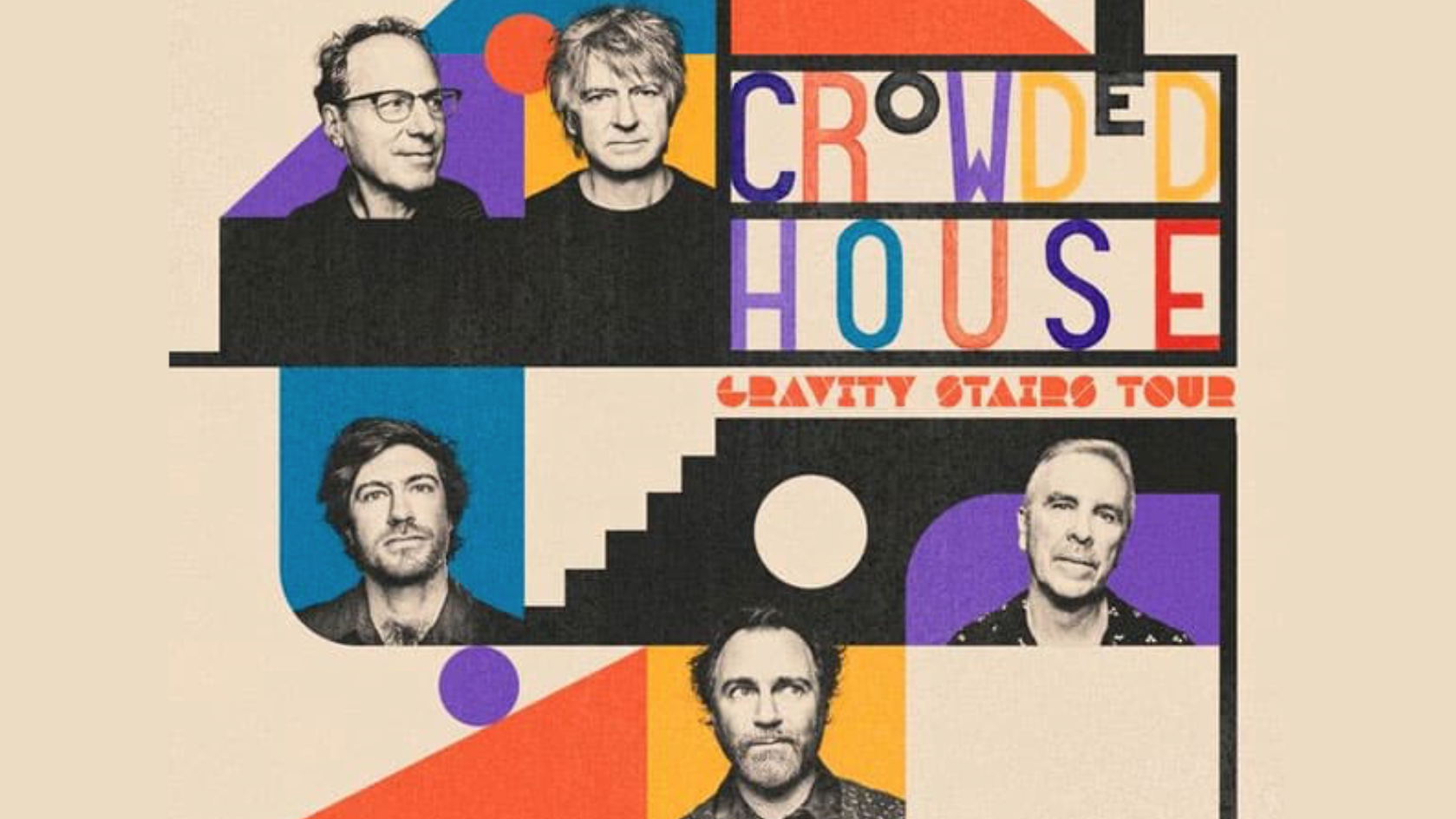
It’s been 40 years since Neil Finn closed shop on his older brother’s band Split Enz, ending their run with an underwhelming swan song LP See Ya ‘Round. Yet just two years later Finn would return helming a new band – Crowded House – that would far exceed what Split Enz had accomplished chart-wise. The self-titled debut Crowded House topped the charts around the world and produced a slew of hit singles, including “Don’t Dream It’s Over” and “Something So Strong.” The band’s commercial fortunes may have ebbed and waned since then but their creative continuity has remained strong throughout three different periods that the group has been active. 1986 to 1996 is often seen as the band’s golden age, producing four albums and more than two dozen memorable songs. But their first reunion period from 2007 to 2018 produced two more albums of classic Crowded House poprock material. Now into their third phase the band have a brand new album entitled Gravity Stairs and it’s like returning to a favourite childhood home, familiar but pleasantly different at the same time.
Reviewers and Finn himself have described the new album as ‘dreamy’ and opening cut “Magic Piano” certainly evokes that. Then again dreamy is practically the DNA of this band, firmly established in the Temple of the Low Men era and threaded through every other release somewhere. So if you’re looking for that vintage Crowded House sound you can definitely find it on this release. Just turn on tracks like “The Howl,” “All I Can Ever Own,” “Black Water, White Circle,” and “Thirsty.” But there are some striking departures as well. Early release single “Oh Hi” shifts the band’s signature pop sound into new territory with some inventive instrumental choices and vocal arrangements. Most recent single “Teenage Summer” has echoes of a Bleachers sensibility while “Blurry Grass” throws up contemporary guitar tones that remind me of Vancouver’s The Zolas. “I Can’t Keep Up With You” honours the album art work’s riffing on Revolver by riding a Beatles ’66 blast of guitar hooks. And then there’s the obligatory Tim Finn duet on the touching “Some Greater Plan (For Claire).”
There’s always room at my place for more Crowded House. Gravity Stairs is another winning addition to the band’s musical family.
Some acts really put on a show. For them, it’s never just some songs. There’s a concept behind what’s there and an order to the proceedings that is every bit as important as the choice of instrumentation and editing of the lyrics. Today’s acts know how to take the spotlight.
Ken Sharp falls somewhere between the Beach Boys and the 5th Dimension. Except when he’s channeling David Bowie or the Beatles. Or Cat Stevens caught between his Brit poppy and pop-folk periods. His new album Welcome to Toytown features an astonishing 41 cuts, admittedly many clocking in at a brief 1-2 minutes. Still, that’s 41 distinct ideas he’s putting out there. One song does run a bit longer – “Toytown Suite” is a medley of three related songs that stretch to 9:43. Now I can’t possibly cover everything that appears here so I’ll leave 33 songs for your own self-discovery and give particular attention to 8 tunes that really grabbed me. Like “Just Hanging Around.” The flute, strings and ukulele are so late 1960s austere England, in a moody Moodies or Kinks mold. “In Betweens” nails that Beatle Paul at the piano. And just tell me “I am a Spaceman” is not a lost early Bowie b-side. “Listen” cranks up the handclaps and piano shots for a baroque excerpt from something off-Broadway. Sharp can even toss us back to the vaudeville era with the spot-on canter of “Got Your Number.” “Stuck in a River of Lies” sounds like the hit single to me. I love the acoustic guitar drive to this one. For a closer I pick the smooth Paul Simon-meets-Elliott Smith whisper vocal and low-key accompaniment of “When It Comes.” Set aside some time to spend with Welcome to Toytown. Trust me, you’ll want to stay awhile.
Bruce Moodyrevived his early 1980s recordings with a fabulous, sprawling package entitled Forever Fresh! to universal indie-scribe acclaim in 2020. But what comes after the belated happily-ever-after of releasing the songs of your earlier self? For Moody, that meant heading back to his old recordings cabinet to recycle even more ideas from his past. Yet on his new album PopCycle he doesn’t just echo his past efforts, he remakes those ideas, rerecording them while branching out from the sound and styles of his yesteryear. Don’t get me wrong, it’s still pretty eighties. But this time around he draws from a broader set of influences from that decade. “I’m Gonna Tell Her Tonight” has a classic 1980s guitar pop sheen. “Shy Girls” has an energy I associate with early 1980s Hall and Oates vibe. “Little By Little” moves into a more pop techno direction a la a daytime Gary Numan. “Labels” is so that decade, both in sound and content. I love the vocal arrangements on tracks like “It’s Not Like Mine” and “Keep It Together.” Then “Turn Away” sounds like the should-be hit-single to me with its carefully calibrated arrangement. So ear candy. With PopCycle Bruce Moody shows the 1980s have still got a lot more to give.
What is Mo Troper trying to say with his new long, long-player Svengali? That he is some evil pop master dominating us with mesmerizing melody? Because I’d sign up for that. Gladly. This new album is certainly captivating, spilling over with 23 songs that punch up multiple styles and include a 6 part instrumental Svengali theme. Things kick off with “Bleach,” a bit of dissonant power pop bliss with blown speakers. The sound comes on like it is being stretched and pulled into shape. Then “A Piece of You Broken Through My Heart” offers a high definition contrast, all jangle clear and buoyant sunshine pop. “The Billy Joel Fanclub” is a bit more mysterious. Serious or satire? The ambiguity is so Troper. Light and dark constantly alternate here. From the rough garage Apples In Stereo “Spark World” and freewheeling punky “The Face of Kindness” to sweet sweeping seventies pop numbers like “You Always Loved Me” and “You Can Call Me Your Baby.” And then there’s the showstopper, “For You To Sing.” The melodic arc on this tune has a magnetic pull that insists on an instant replay. But I’m also charmed by the breezy rollicking flow of “Like I Do.”
As you can hear, underneath all the high production trappings are some great songs. Enjoy the show over and over again via the artist hyperlinks. You don’t even have to buy a ticket (but that would be nice).
Why waste time searching the radio dial for hooks when we’ve got you covered right here? Today’s post promises both something new and a return of familiar faves, all packaged up to be stylishly long-playing.
Just one spin of The Embryosnew album Selling What You Want To Buy confirms they know their market research. There’s so much to love on these 11 finely crafted songs, performed in multiple styles. I continue to be impressed by the band’s easygoing facility with just about any rock subgenre, though if I were forced to slot this new album in somewhere I’d say it has a decidedly Americana accent in places. This was on display strongly on the pre-release single “Desiree,” a breezy mid-1970s Eagles country-ish romp. And it’s there again on the Band-like “Sweater in the Heather.” Then you have tracks like “He’s a Hypocrite” which exude a Marshall Crenshaw vibe that easily shades into Americana. But the band’s penchant for Brit influences remains too, mostly audibly on “Somehow She Knew” and the record’s hidden title track “The Embryos Live” which lyrically features the album title and some alluring psychedelic lead guitar. “Frozen City” sounds like the should-be single to me, with the light and bouncy “Fortunes” a close second.
For another aptly named release, you can turn to David Woodard’s latest LP Get It Good. Now given that his 2022 album Stupid Kid was not merely good but great can we expect Get It Good to be even better? The opening track “The Last of the Full Grown Men” is certainly promising, kicking off with a strong Beatles ’66 vibe before morphing into a kind of Fountains of Wayne suburban anxiety song. It also hints at a lyrical depth that defines this album as Woodard grapples with issues of aging (“I Used To Be Cool”), nostalgia (“Flower Power in the 80s”) and social alienation (“I Can’t Make The World A Better Place”) on various songs. Musically the record steers between sixties and eighties influences. For instance, like “The Last of the Full Grown Men” “Coming To Life” also launches with recognizable Beatles motifs before moving in a more Odds direction. There’s even some recognizably U2-ish lead guitar setting the atmosphere on “Crazy One.” But I think where he excels is with the more low-key, midtempo FOW numbers like “Grace Under Pressure,” “Get It Good” and “Awkward Conversations” because there’s no place to hide – the melody has got to be good (and they are). “Riptide” is striking outlier here with its wistful electric piano layered over an ominous set of synth strings.
Apparently you can’t hurry a band like Aerial. It’s been ten years since this Scottish duo put out Why Don’t They Teach Heartbreak In School and that record had come 13 years after their debut LP Back Within Reach. But now they’ve returned with Activities of Daily Living and it’s like no time has passed at all. The title track opener signals strongly that the band’s power pop chops remain undiminished. Then “Pixelated Youth” adds a pinch of dissonance to the mix, offset by some sweetly melodic vocal work in the chorus. The band’s signature, self-described ‘smash and grab’ style of power pop can be found on both “An Encore and Cover Song” and “Bad Tattoo.” But there are departures too. “Hollywood Ghosts” has an AM radio hit-single sheen all over it while “Run These Lights” is more of a mellow, ambient mood-setter. The album also features a number of gorgeous, moving piano ballads like “Debutante” and “Silversand Beach.” But my personal faves lean into the Teenage Fanclub/FOW kind of melodic guitar pop, specifically “I Bet You Know Karate” and “Cadence.”
Harvey Gerard looks the part of a loveable loser and lyrically his work is etched full of trouble, chaos and social ennui. But musically he consistently manages to turn that frown upside-down on his latest album Cul De Sac. That’s kinda impressive. He may be singing about drunken nights on the bar stool (“Bar Stool”) or seasonal mental health episodes (“Quarterly Paranoid Cycle”) but somehow it comes out sounding like there’s an upside. The trick is to bring in some sweet harmony vocals and an extra hook somewhere, usually in the chorus. I mean, look at the structure of opening cut “Last Days of the Hated Family” where the deft application of back-up vocals in the chorus totally elevates the tune. The sound here is miles away from the trainwreck country vibe (not that there’s anything wrong with that) of his 2017 release Pickled Wisdom. Echoes of previous work can be found on the country-ish “Thin Lipped and Nordic” and “Left To My Own Devices” but overall that album leans poppy rock, particularly on tracks like “Phase Pedal” and “Nervous Energy.” Should-be hit-single is undoubtedly title-track “Cul De Sac.” Compositionally it’s got a McCartney-esque complexity, developing different sonic layers and delightful melodic twists throughout.
These LPs are not going to race up the charts all on their own. Click on the hotlinks to register your approval.
As a metaphor, flight is pretty self-explanatory. To say things ‘take flight’ or end up ‘grounded’ lets the reader know where things stand fairly quickly. Today’s post sees three bands chart distinctive flight paths but you’ve got to listen carefully to see where each goes.
Sunken Planes have got an early REM vibe animating the tight collection of songs on their Intersections EP. You can definitely hear it on “Two Trains” and “The Ghost of Jennifer Bradley.” Should-be hit single “There’s a World” spreads the sonic influences a big further, over a host of other college bands from that decade. Then “Constellation Light” initially strikes a different mood before resolving into the band’s signature, self-described ‘jangle-shoe gaze’ sound. The most serious outlier on the record is “Doppelganger” with its almost jazzy chords and lead guitar lines and distinctive harmony vocals in the chorus. My only complaint here is that everything ends too soon, given the brevity of this EP’s five songs – start to finish barely cracks a quarter hour. A debut long-player can’t come fast enough for me.
With a name like On the Runway you might expect a sense of urgency from this band. But the songs on Tell Yourself It’s Pretty mostly vibe a pretty mellow jangle. Some are very early 1980s soft rock, like the atmospheric “Set For Life” and “Stuck On You.” Others have a more 1970s Fleetwood Mac feel – here “Loser Of The Year” comes to mind. Then you have tracks like “Consolation Prize” that exude a sombre intensity, even as they throw out some solid melodic hooks. For singles material I would nominate the guitar-driven “This Charade” and the almost anthemic “This Will Be Your Year.” The material on this alum is really something meant to heard on an AM transistor radio. For a study in tempo contrasts, check out how things really slow down on “House Is Not A Home,” a quiet pop song that is almost whispered but enlivened by ringing guitar tone, while “Bring Yourself Down” picks up speed right as the album ends.
Talk about an aptly named album. The Speed of Sound’s new LP A Cornucopia: Minerva really is buffet-style serving of multiple musical styles. There’s a bit of Bo Diddley boogie, Velvet Underground swagger, and 60s melodious beat – and that’s just the first three cuts. John Armstrong and Ann-Marie Crowley share vocals duties in a creative tension on nearly all the songs, the former pulling in an Anglo-Lou Reed direction, the latter evoking an Alison Moyet pop confidence. With 14 songs here there’s plenty to choose from in terms of highlights. Personally, I’m drawn the straightforward poprock efficiency of “Clickbait” with its slight snarl. “Yet Another Tuesday” sounds like a punked up Monkees to me. However, my fave is undoubtedly “Question Time.” I love the multiple guitar hooks as well as the spot-on lyrical sentiment.
You won’t need a boarding pass to access these high flyers. Just click the hyperlinks to get airborne.
With just five songs featured on this post it may appear to be an abbreviated episode of Cover Me! but I still think it’s worth your while stopping by. “Whenever You’re On My Mind” is one of my all-time favourite songs. For me, there’s just no way anyone is going to touch the transcendent beauty of Crenshaw’s original. Initially recorded during sessions for his debut album, the song didn’t quite fit and ended up the lead single on his fabulous second LP Field Day. Talk about making a good first impression, the track opens the album with one of the most seductive guitar hooks of all time, the vocals are a master class in power pop elocution, and the production is so brilliantly, sibilantly Steve Lillywhite good. Frankly, running the search engines on YouTube, Bandcamp and iTunes, it doesn’t appear that a lot of people have been up for the challenge of covering such a formidable composition and performance. But there have been a few worthy attempts.
We start with Marshall, of course. For a different take from the single and album cut you can find a live version of “Whenever You’re On My Mind” on his 2021 collection The Wild Exciting Sounds of Marshall Crenshaw. The 1983 video for the song is worth a viewing too, if only for its time capsule feel for an early 1980s look and ambience.
In terms of covers, we begin with the most inventive. Working with REM producer Don Dixon, Marti Jones put out a number of albums in the 1980s that saw her put her stamp on a host of songs from the likes of Elvis Costello, Dwight Twilley, David Bowie, and John Hiatt. Her cover of “Whenever You’re On My Mind” appeared on her 1986 album Match Game, which Marshall Crenshaw played some 12 string guitar on, though not on his song. What is striking on her cover is how she changes the vocal emphasis on the lines in the chorus. Girl group legend Ronnie Spector did a whole EP of Marshall songs on 2003’s Something’s On My Mind. She too added a few surprising twists and turns to the song’s melodic arc here and there that really work. I only know Zach Jones from his spot-on Monkees reincarnation track from 2020 “Must Be On My Way.” His 2016 acoustic approach to covering “Whenever You’re On My Mind” lightens the power pop intensity, gentling the vocals and guitar attack. The effect is reassuring rather than bracing. I really like the guitar tone and ramshackle vocal on Michael Fiore’s cover from the same year. There’s a rehearsal space Replacements vibe to this rendition. The Kavanaghs hail from Rosario, Argentina and put Marshall’s song on the b-side of their 2021 single “Going To The Beach.” The latter is more of a vamp-ish rocker so their cover shows they can’t handle the more melodic side of the street too. Why more people don’t cover MC is a mystery to me, given the results on display here with just these five submissions.
Marti JonesRonnie Spector
Need more Marshall? Who doesn’t. Get on over to marshallcrenshaw.com to find your Marshall merch, show tix, latest news and records.
Forget the Elvis Costello tune, today’s feature is really just a staging post for bands that know how to cast a moody ambience over their recordings. Some are dark, awash with shade and mood lighting, while others seem to tweak the brightness of each hook they throw. You can take your pick of moods on offer here.
Hovvdyare masters of textured atmosphere. It jumps out and envelops you on their stand-out single “Jean.” I hadn’t even written a line about them when I included that release in my top 5 folk pop list for 2023. Now they’re got a whole album of similarly intriguing material on their recently-released fifth long-player, the self-titled Hovvdy. The LP has 19 songs that feature their amazing talent for conjuring a sonic warm blanket out of a mixture of instruments and dreamy vocals. Some selections are little more than evocative fragments of melody that get incorporated and developed elsewhere. “Forever Piano” is a striking 21 second piano riff that loses a bit of bite but gains melodic depth on the longer “Forever.” Other tracks range across styles but keep to the album’s over-arching sonic décor. For instance “Clean” vibes a DIY, lofi Elliot Smith feel while “Make Ya Proud” has more studio polish. But both are just different flavours of what I might call ‘rogue folk,’ if you’re prepared to envision New Order as back up players here. Other highlights for me include “Big Blue” and “Portrait,” the latter sounding very country with a vocal that rumbles like it was recorded in a big empty room.
10 years after their debut LP She Looks Like Kim fell to earth and three years since their major label debut Discover Effortless Living York’s Bull deliver a sweet sweet third installment with Engines of Honey. Everything here is similar – but different. The design is punchier, the production is brighter, but the songs are familiarly good. Even though the band is back on independent footing having left EMI they clearly retain the poise and polish they gained there. Album opener “Start a New” is a winning poppy number with a melodic skip in its step. From there it’s hooks aplenty, whether delivered as power pop as on “Head Exploder” and “Crick” or with a smoother sheen on “Sid” and “Stranger.” “Red Rooves” even vibes a bit of Bleachers to my ears. The departure tune is “Imaginary Conversations” which manages to overlay a choral vocal quality on its jaunty tune. And if you really want to see how far this band has come in a decade, check out their remake of “Jan Fin” from their first album. They really imbue the song with new life.
The new Seasonal Falls album Happy Days is a lush sonic vista, where the melodic detail and pacing choices on each of its nine tunes exhibits the care of a fine pointillist painting. Title track and opening cut “Happy Days” meanders into view, lulling us with its alluring melody. “Used To Be Fun” almost seems to skip along, picking up the pace ever so slightly. There is a McCartney-esque calibration of carefully worked out guitar motifs and vocals here. Then “Lie Down” almost breaks the album’s spell, vibing a more indie rock feel – almost. You could think of this album as different shades of the same colour, each song being distinctly different but clearly relatable to the others. It all comes down to choices on tempo and instrumentation. On this front “Girlfriend” is a masterful bit of song staging, opening with such precise restraint only to slowly add more colour and sonic depth along the way. Or listen to how the country-ish tinge to “Half Moon” lends a sense of urgency to the song. I also like how “Hey Girl” deploys ‘oh oh oh oh’s to good effect, creating an almost conventional pop tune. Should be hit single? Definitely “I Wish You All The Best” with its Neil Finn sense of low-key assurance.
Stellar Evolution is album #5 for Nashville’s Aaron Lee Tasjan, another installment in his genre-defying exploration of subtle melodic hookyness and lyrical openness. Times are tough in the American south and Tasjan gives voice to how the national right-wing war on diversity lands there with particular ferocity. As he sings on “Nightmare,” ‘I’m fearing for my life’ because ‘Mama they wanna kill me.’ The song’s relentless yet even synth backdrop effectively frames a harrowing narrative. Throughout the album Tasjan’s songs are snapshots of living amidst all a kind of social carnage. “Roll Your Windows Down” paints a joyous picture of connection that needn’t be tidy. “Bird” is a peppy track about getting up every day even if you’re going nowhere. And a host of songs here specifically capture queer alienation, like “Horror of It All.” But for caustic commentary on more explicitly political topics, see the hard-hitting “I Love America Better Than You.” Should-be hit single definitely would be “Alien Space Queen,” a boppy rumination on living with difference. But I also really like “Cry Till You’re Laughing” for its Beatlesque grandeur and just a dab of ELO. Then things close starkly with “Young,” a track that will tug at your heart with the gravity of a queer Springsteen. On Stellar Evolution Aaron Lee Tasjan offers up beautiful, heartfelt testimony to coping with and even defying America’s current ugly mood.
We’ve offered moods for many occasions so take your pick. These artist are waiting to cast their spell via the hyperlinks appearing above.
There’s something meditative about Grant Lindberg’s new single. “In My Own Way” is slightly droney, sounding almost like an Oasis throw-back but without the sneer. As the song builds the layers pile on but without taking away from the light and buoyant quality of the song. Things start spare, just vocals and acoustic guitar, adding drums, some whammy-barred electric guitar, and a Jon Brion keyboard wash along the way. But then in the instrumental break things suddenly go unmistakeably early 1970s Lennon-esque. The single really feels like a departure for Lindberg, seeing him step away from his usual penchant for 1990s dissonance and a more rocking wall-of-sound for a genius combination of more subtle sonic inferences. The execution also sounds effortless, like we’re floating along, nudged forward only by melody and the slow beat of the bass drum. Over on his Bandcamp site Lindberg does hint that this might amount to a sneak peak at his new LP. Or it might not. Not every one-off single he’s released there has ended up album bound. Still, given the compositional creativity of “In My Own Way,” we can only hope this is the start of something long-playing.
While you wait for a new Lindberg album you can reacquaint yourself with all the old ones here.
Workers Playtime was a BBC radio show that ran for two decades after WWII, broadcasting live music and comedy from shop floors across the UK. As culture should do, it held a mirror up to what the great mass of people do day in, day out, as if that mattered. On today’s May Day we revive that spirit with a collection of songs that also focus on work, working, and workers.
I’ve never heard anyone capture the essential problem of work in a song quite like Birmingham, Alabama’s Lolas. Running just shy of two minutes, “Work is the Blackmail of Survival” beats its jangle fueled fist against the tyranny of modern employment. Not that Lolas leader Tim Boykin could be accused of sloth, given how he regularly churns out great tunes. His real concern is about how work for pay tends to stunt out lives, alienating us from ourselves and others. Boston’s Air Traffic Controller are not clear on what kind of employment they’re writing about on “The Work” but it doesn’t sound like a walk in the park. But like Lolas they still sound chipper about it, musically at least. Cotton Mather main man Harold Whit Williams has another project that is right up our themed alley. Writing and performing under the moniker Daily Worker he has a whole album entitled May Day. On “Write If You Get Work” he offers a folk pop rumination on the struggle to get work in seemingly never-ending tough times. In a related vein Canadian power pop juggernaut Sloan weigh up the pros and cons of any given work opportunity on “Nice Work If You Can Get It” with a few Beatlesque guitar hooks just to sweeten the deal.
Our next group of songs are about working. On his website Paul McCartney writes about “On My Way to Work” from his 2013 album New. Ever the wistful one, Macca does capture the mood of his pre-Beatles working class self going to work, mind on other things. On their last album in 2011’s Sky Full of HolesFountains of Wayne tucked in one of their usual stellar daily-life song sketches with “Workingman’s Hands.” With a quiet respect, the song’s lyrics honour the impact of work on those who do it. Jack Green’s 1980 album Humanesque has a unique blend of guitar and vocals that is so of the era. It also includes the rhythm guitar chord fabulous tribute to working class gals on “Factory Girls.” The light synth touches are just a bonus. Reaching back to 1973, the struggles of working class couples with conflicting shifts gets an airing on the Liverpool Echo’s “Sally Works Nights.” Though I doubt the protagonist’s solution here really met with Sally’s approval.
Paul McCartney – On My Way to WorkJack Green – Factory GirlLiverpool Echo – Sally Works Nights
Shifting gears, work is the focus of a lot anguish in terms of how it limits what people can do with their lives. Philadelphia’s 2nd Grade neatly sum the essential problem on “Work Till I Die” where the singer works and works to gain ‘free time.’ Similarly Richard Turgeon bemoans the days lost to “Workin’ for the Man.” As he notes lyrically “There’s a moral to this story but it might not have a happy ending.” The Primitives left space on their fabulous 2014 comeback album Spin-O-Rama for a soliloquy about how hard labour sucks on the delightful “Working Isn’t Working.” And they throw in some pretty special glam buzz guitar too. Then there’s Cupid’s Carnival giving their best Beatles treatment of their own “Working All Day.” It almost makes suffering the work day worthwhile.
Cupid’s Carnival – Working All Day
This May Day as much as any we have to ask why the great mass of working people put up with their situation, given that they represent the overwhelming majority of humanity. Chris Corney suggests it might have to do with a particular mindset. On “Do Not Adjust Your Mind” he addresses how people let things go rather than interrupt the flow. Robert Ellis Orrall puts the blame on a broader set of ‘doing stupid man things’ that dominate so much behaviour. What people need, according to angry troubadour Ike Reilly, is to abandon a fake past and embrace of real future and “Fuck the Good Old Days.” Amen.
Chris Corney – Do Not Adjust Your MindIke Reilly – Fuck the Good Old Days
This moment in history is no workers’ playtime. While AI fiddles our future as workers burns, unless we collectively decide otherwise.
Nowhere to go, nothing to do – parking with the radio on was pretty much a regular teenage thing to do back in my day. You might even punch the pre-set radio station buttons and catch the same song playing on different stations! But there are no repeats here. Just 21 singles itching to make your car-time playlist.
We kick things off with David Brookings touching love letter to his wife on “Shelby.” A nice midtempo pop tune giving voice to those age-old sentiments of couple love and companionship. The track is featured on an EP of the same name amidst a few song sketches about cancel culture, football names and a lullaby. Next we crank the pop meter with The Cynz on “Crow Haired Boys.” The song comes on strong with blasting opening chords and drums only to lull us with solid melodic interludes. Erin Din is something else, sounding more like those 1970s English folk rockers Roy Harper or contemporaries like Ed Ryan. “On Top of the World” ambles along with a rhythmic hypnotic quality. From Hanover, Germany comes a stripped down affair under the moniker A Boy Named Song. “You Got the Beat” carefully measures out its sonic interventions – guitar part here, vocal line there – until it all comes together in the chorus. A bit Stonesy, Tom Petty, or even The Replacements. The Midnight Callers are signalling they are coming back power pop strong with their new single “The Eraser.” Fans are comparing it to the Raspberries or The Flashcubes and I’d concur. Worthy b-side award for the band’s energetic cover of The Who’s “Substitute.”
Minneapolis music scene veterans Electric Beauty fill the time between albums with a choice cover of Peter and Gordon’s 1964 hit “I Go To Pieces.” It’s hard to miss the mark with such a great song and the boys do not disappoint. Another band filling time between major releases is Taking Meds. Their new 3-song EP Ext Meds includes an amazing re-interpretation of My Bloody Valentine’s “Drive It All Over Me.” Talk about re-inventing someone else’s tune – TM add more melodic depth to the song while featuring some really special tone on the guitars. You might think that half a band would lose something but The Half Cubes, literally half the membership of power pop stalwarts The Flashcubes, manage to tap into a whole different well of melodic rock goodness. Their new single is a cover of The Rubinoos “The Girls” and features help from original Rubinoos members John Rubin and Tommy Dunbar. The results are dynamically ear-worm good. The Jellybricks are also working on a new album and drip-releasing singles to keep fans on the hook. “All About You” bodes well for what is coming, with a magnetic melodic pull to the tune. Toronto band Mad Ones work a classic descending chord progression with mesmerizing intensity on “Stranger Stranger.” More of the good same can be found on their new album What It Takes.
Electric Beauty – I Go To Pieces
Henry Chadwick works up his most pop psychedelic Beatles vibe on “I Hate the Sound,” a single from his new EP Leaving. It has a spare, spacey other-worldly quality like a kind of melodic meditation. For something a bit more driving and droney Quadruple A offer “Easy Rolling,” though get ready for a melody break-out in the chorus. This is Pennsylvania poppy rock at its finest. Now that southern California quintet The Armoires have finally produced a theme song you can just tuck this in front of the rest of their back catalogue. “We Absolutely Mean It” is a manifesto of musical intent, where making music is about having fun and bringing people together. The sunshine meets psychedelic pop backing is the perfect staging for this sentiment. Steve Conte has got a musical resume that goes on and on, working with artists as disparate as Prince, Peter Wolf and the New York Dolls. On this new LP Concrete Jangle his puts his own unique stamp on things, conjuring 1980s-style popping rock tunes like “Girl With No Name.” By contrast Dave Cope and the Sass reach further back, to a more fertile jangle scene we associate with the mid-1960s. “Precious Heart” lashes out from the start and grips you in its inescapable jangly melodic embrace. And there’s more of the same all through his fabulous new long-player Hidden From the World.
There’s something special about the distinctive sonic atmosphere Sad About Girls manage to create on all their releases. “She’s Not Here” from their new EP of the same name is no exception. Their vibe is slightly dissonant but always with a solid melodic punch in the chorus. And the EP contains a fabulous cover of Split Enz’s “History Never Repeats.” What’s a mere 18 years between records? Glasgow band Martial Arts just pick up where they left off, offering up more of their carefully crafted chamber poprock. New single “No Victory” has the pop drama chops of all those early 1960s and 1970s disaster songs. It’s enjoyable stress free crisis in a 4 minute song. Don’t know much about Brooklyn trio Wifey except that their debut single “Mary Ann Leaves the Band” is an unstoppable hook-filled aural assault, in the very best kind of way. Word is that an EP is coming entitled Just a Tease. Everything about LA band The Reflectors says its 1979 again. It’s the album covers, the outfits, and – of course – the songs themselves. Their new record Going Out of Fashion is one long love letter the late 1970s guitar band revival. But the standout track for me is “Supernova,” with its sly hooky twist in an otherwise understated chorus. Before you know it, it’s got you in its earwormy grip. I’d add “Time Is All I Have” as a worthy b-side. Words like ‘haunting’ accompany the work of Alabama’s Secret Sisters. Riding a fine line between Americana and country, their new release is Mind, Man, Medicine. There’s a lot to like here but right now I’m hooked on “Paperweight” with its Patsy Cline meets Neko Case rockabilly flair.
The work of Michael Goodman as Goodman is an enigma, unclassifiable in terms of genre. But whatever it is, I find myself drawn to whatever he puts out. His new single “Only Testimony” is grand and sweeping, except when its subtle and alluring. The guitars, piano and synth are crisply arranged to overlap and meld while the mix of vocals and harmonies are captivating. From a promised new album in the works.
There’s no danger of being hit with a parking violation for stopping here. You can idle away the time with these radio-friendly songs in park or drive.
Photo ‘Found Kodachrome Slide’ courtesy Thomas Hawk Flikr collection.
Good thing jangle isn’t a limited resource. In fact, you could say it can be renewed every time someone picks up a guitar and chooses the appropriate effects-pedal/amp. To that end, today’s bands dial up the reverb to re-up our supply.
On Out of Reach northwest English band West Coast Music Club continue to develop their sonic palette. Things start out strongly jangle with “Sick and Tired,” a cutting political statement that musically conjures echoes of The Who’s “The Kids Are Alright” and The Byrds doing “Mr. Tambourine Man.” Then “Out of Reach” combines transcendent harmony vocals with arpeggiated guitar work in a style that is so REM. Songs like “The Only One” change things up, striking a more Jake Bugg kind of sombre intensity. The album also collects together various singles from the past year, like the ethereal “There She Goes Again” and the jaunty Lou Reed-ish “Nobody Likes You.” The album turns more folk near the end with both “Home” and “Turning in Circles” opting for a more acoustic guitar staging.
Calling their new album #2 Record is one way Memphis power pop outfit Your Academy can signal they’re reviving a key local indie brand. And in so many ways this record does mark a strong resurrection of Big Star’s distinctive jangle vibe. “My Near Catastrophe” is a case in point it so resembles the original act in sound, tempo and hooks. But Your Academy are more than just Alex Chilton’s children. “Marilu” sounds like so many great contemporary bands working the harmony vocals/melodic rock and roll scene these days, like say The Maureens. At other points the Big Star style gets subtly modified, as when “Just a Little Out of Tune” appears to add a dose of Wings, or just harkens further back in time, as on the more Byrdsian “Wasting Time.” Personally, I hear more than little Moody Blues on this record, whether we’re talking the spot-on Justin Hayward vocal of “Miss Amphetamine,” the more power pop version of the Moodies on “(Not) Forever After All,” or that band’s over-the-top pastorally poetic inclinations on “B 612,” a tribute to the book The Little Prince. Other departures include the ambling Americana of “Greta” that features some snappy electric piano and distinctive harmony vocals. Then again, tracks like “When We Dream” just deliver the goods – relentless jangle.
Chicago’s The Boolevards have a sound that shifts between 1965 and 1978 on their new LP Real Pop Radio. Tracks like “On the Run” have that jaunty mid-sixties energy, still innocent of the heavier themes that would come later. “Last Night” even cheekily nicks the signature harmonica riff from “Love Me Do.” Then “If I Gave My Heart To You” and “Bittersweet” offer serious jangle from the Merseybeat playbook. But the other audio landscape marked out here is that poppy light rock that resurfaced in the mid-1970s as a precursor to various waves of indie to come. Here “It’s OK,” “Dance All Night,” and “Just Another Lousy Day” all have a compressed 1970s pre-New Wave sound. I really like how both “One More Chance” and “Out of Breath” use distinctive guitar tones to elevate the proceedings. “Get Out Tonight” even rocks things up a bit. With 16 tracks Real Pop Radio tirelessly barrels along song after song exuding positive poppy sentiments.
From the opening strums of “Hollowed Out,” the kick off track to the new Ducks Ltd. album Harm’s Way, you know you’ve dialed into something special. By the chorus you’ll be ready to get your fist-waving, pogo-dancing party shoes on. This is jangle pop with extra degree of intensity. Both “Cathedral City” and “The Main Thing” spit out lightening lead-guitar hooks with relentless precision. “Train Full of Gasoline” is a more even ride, though no less steely on impact. People compare this band to REM but I hear more of The Silencers or Grapes of Wrath, particular on cuts like “Deleted Scenes” and “Harm’s Way.” You’ll want to get out to see these boys live if they come to your town just so you can dance to the unstoppable beat of “On Our Way to the Rave.” The record does hit the brakes with its closing track “Heavy Bag,” giving acoustic guitar and mournful strings a look in. Harm’s Way is 28 minutes of quality jangle like no other, a 2024 must buy LP.
Jangle is both a tone and vibration and these bands have locked in on to both. Fill out your collection with the hyperlinked LPs above.






 Poprock Record